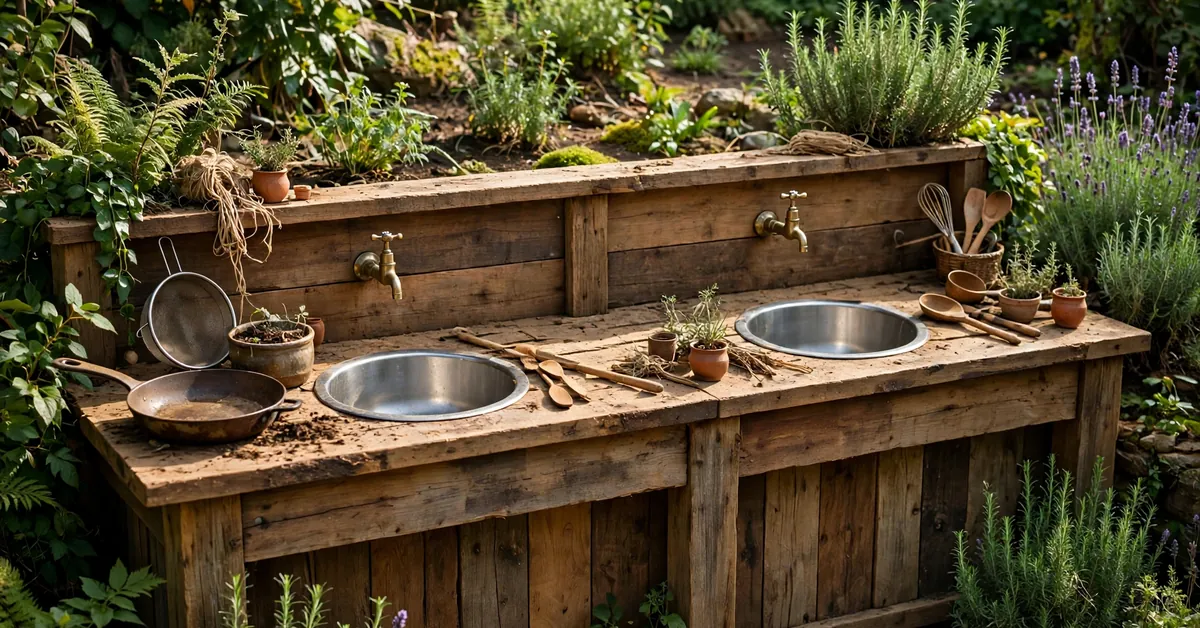
Every mud kitchen I’ve built started with one bowl. And every single one ended the same way: a queue. One child washing pebbles, another one hovering with a muddy teapot, and a small but very serious argument about whose turn it was to use the “sink.”
The fix turned out to be embarrassingly simple. Two bowls.
A double sink mud kitchen sounds like a luxury upgrade, but in practice it’s the difference between a kitchen that gets fought over and one that actually flows. One bowl becomes the washing-up bowl, the other the rinsing bowl — exactly how a real kitchen sink works, and exactly how children instinctively want to play. Here’s why it works, the design options, and how to build or convert one without making it harder than it needs to be.
The washing-up station insight
Watch a child at a single-bowl mud kitchen for ten minutes and you’ll see the bottleneck. Everything happens in one bowl: the mud pies soak, the leaves get washed, the “soup” gets stirred, and the cups get rinsed in the same murky water. It works, but it’s chaotic.
Two bowls split the jobs the way a grown-up kitchen does:
- Bowl one: washing. This is the dirty-work bowl — mud, leaves, stones and conkers go in here with water, get scrubbed and swished.
- Bowl two: rinsing. Cleaner water, for rinsing the “washed” treasures, filling cups, and serving up the finished creations.
Children pick up this workflow almost immediately, because it’s the same one they see at home. And when one bowl is occupied by a long-term mud-pie soak, the other is still free. The queue disappears.
The real benefits of two sinks
Two children play side by side, not in turns
This is the big one. A double sink kitchen naturally seats two children shoulder to shoulder, each with their own bowl, sharing the worktop between them. Siblings, cousins, playdates — parallel play stops being a negotiation. Each child has their own station, and collaboration (“you wash, I’ll rinse”) happens on its own.
The wash-and-rinse workflow keeps play going longer
Single-bowl play stalls every time the water gets too muddy to see in. With two bowls, one can be emptied and refilled while play continues in the other. Sessions genuinely last longer, because the setup keeps offering a next step: wash it, rinse it, serve it.
Water play and dry sensory play stay separate
A second bowl doesn’t have to hold water at all. Use one bowl for water and keep the other dry — for sand, dried lentils, pinecones, or the day’s nature treasures. That separation matters more than it sounds: dry materials stay usable instead of turning to sludge in the water bowl, and children who prefer not to get wet hands still have a station.
It grows with them
For toddlers, two bowls means simple scooping and pouring at their own spot. For four- and five-year-olds, the same setup becomes a proper pretend café or potion lab with a washing station and a serving station. You won’t need to rebuild in a year.
Design options: four ways to get two sinks
There’s no single right layout. These are the four I’ve seen work, from simplest to most built-in.
1. Two inset bowls in the worktop
The classic look: two round or rectangular bowls dropped into two holes cut in the worktop, just like a real double sink. Mixing bowls, washing-up bowls or small stainless basins all work. This is the most “finished” option and the easiest to keep clean, because the bowls lift out for emptying.
2. One big trough, split visually
A single long trough or storage bin sunk into the frame, divided by a line of pebbles, a small plank, or simply by use — one end for washing, one end for rinsing. Cheapest option, and brilliant for younger children who aren’t ready for boundaries anyway. The downside: it really is one body of water, so the wash/rinse separation is a polite fiction.
3. Bowl plus bucket, side by side
No cutting required. Put your existing inset bowl on one side and stand a sturdy bucket or basin on the worktop (or on a low shelf extension) beside it. It looks a little more improvised, but it’s a genuinely good way to test the two-sink idea before committing to a rebuild — especially if you’re converting a kitchen your child already loves.
4. Twin tap containers over one or two bowls
If your kitchen has a water container with a tap, two smaller containers — one over each bowl — give each station its own water supply. This pairs beautifully with two inset bowls and is the setup that most convinces children they’re running a real café. More on water arrangements below.
Building a double sink mud kitchen (or converting one)
Start with the width
Two bowls need a wider kitchen. A comfortable double setup wants a frame roughly 110–130 cm wide — enough for two bowls of 25–35 cm each, a strip of worktop between them, and a little elbow room at the edges. If you’re planning a build from scratch, it’s worth checking the full sizing guidance before you cut anything mud kitchen dimensions, and if you’re working from a plan, most single-sink plans adapt by widening the frame and adding a second cut-out mud kitchen plans.
Cutting two sink holes
Mark both bowl positions on the underside of the worktop plank, centred on each half of the frame. Trace the bowl, then draw your cut line about a centimetre inside the traced line so the bowl’s rim rests on the wood rather than falling through. Drill a starter hole, cut with a jigsaw, and sand the edges smooth — little hands will run along these rims daily. Test-fit both bowls before you fix the worktop down.
Support matters twice as much
Two bowls of water are heavy — a full 5-litre bowl weighs about 5 kg, and children lean on rims. Add a support batten under the worktop between the two holes, and make sure each bowl is carried by its rim on solid wood, not flexing in the middle of a wide, unsupported plank. Give the whole frame a firm push test from a few angles before the first play session.
Drainage and emptying
Bowls without drain holes get emptied by lifting them out — design for that. Leave enough finger room around each rim to grip and lift, and don’t seal the bowls in permanently. If your bowls do have drainage holes with stoppers, run both over a gravel patch or a gap between decking boards so muddy water disperses instead of pooling under the kitchen.
Converting a single-sink kitchen
Good news: most single-sink kitchens convert in an afternoon. If the worktop is wide enough (100 cm plus), cut a second hole beside the first. If it isn’t — and many pallet kitchens aren’t — use the bowl-plus-bucket option on top, or bolt a simple side extension shelf to the frame at worktop height and drop the second bowl into that. The extension route is reversible, which is handy if you later change your mind.
Water setups for two bowls
- One shared container. A single water butt or dispenser centred above both bowls, with the tap reachable from either side. Simplest plumbing, and refilling happens in one place.
- Two containers. One smaller dispenser per bowl. Each station is independent — one can hold water for washing, the other can be left empty for a child who wants a dry bowl. Refilling is a bit more frequent.
- A pump or pour-over jug. For children who love the pouring more than the tap, a simple hand pump or a big jug kept on the back shelf works fine and slows water use down on hot days.
Whichever route you choose, the same rules apply: food-safe containers, emptied and rinsed regularly. If you’re setting up running water for the first time, the full walkthrough of containers, taps and pumps is worth a read before you buy anything mud kitchen with running water.
Buying a ready-made double sink mud kitchen
Plenty of ready-made wooden mud kitchens now come with two bowls as standard, especially the wider models aimed at siblings. If you’re buying rather than building, check:
- Bowl material. Stainless steel and sturdy plastic both survive outdoors; thin plastic basins crack after a season of sun. Check whether the bowls are removable — fixed bowls are much harder to keep clean.
- Bowl size. Bowls around 25–35 cm across are the sweet spot. Much smaller and nothing fits; much bigger and the worktop disappears.
- Stability. A wide kitchen should have a correspondingly wide, braced frame. Look for cross-bracing at the back and avoid tall, narrow designs that rely on the bowls for stiffness.
- Worktop height. Around 50 cm suits most 2–5 year olds; some models offer an adjustable or slightly taller worktop that buys you extra years.
Typical prices (labelled as typical ranges, not current listings): ready-made double sink wooden mud kitchens usually sit somewhere in the £90–£220 / $120–$280 range depending on size, wood and extras, with larger premium brands above that. The DIY route — pallet or timber frame plus two household bowls — typically comes in around £25–£60 / $30–$75 in materials if you already own basic tools.
Safety and hygiene with two bowls
Two bowls mean twice the standing water, so the basics matter:
- Empty both bowls at the end of every play day. Standing water grows slime and attracts insects fast in warm weather, and stale mud water is nobody’s idea of sensory play.
- No unsupervised water play. As with any water, young children play with an adult nearby — two bowls don’t change that rule, they just double the splashing.
- Check stability on the wider frame. A 120 cm kitchen is a bigger structure. Anchor tall back boards if the design has them, keep the frame on level ground, and re-tighten screws each season.
- Rinse bowls weekly with hot soapy water, and scrub any slimy film off promptly — children put mud-kitchen utensils in their mouths far more often than we’d like.
Frequently asked questions
Is a double sink worth it for one child?
Often, yes. Even a solo player uses the wash-and-rinse workflow, and one bowl can stay dry for sensory materials while the other holds water. It also future-proofs the kitchen for playdates and younger siblings. If space or budget is tight, though, a single generous bowl is still a perfectly good kitchen.
What size bowls fit a double sink mud kitchen?
Bowls of roughly 25–35 cm across work best in pairs — washing-up bowls, mixing bowls and small stainless basins all fit that range. Two bowls plus a worktop strip between them is what drives the overall kitchen width of about 110–130 cm.
Can I convert a single-sink kitchen to a double?
Usually, yes. If the worktop is 100 cm or wider, cut a second hole. If it’s narrower, add a bowl on the worktop or bolt on a side extension shelf with its own cut-out. Many conversions take under an afternoon with a jigsaw and a spare bowl.
Do both sinks need a tap?
No. One shared dispenser centred between the bowls serves both stations perfectly well, and many families use a jug for one side. Two taps are a nice extra for fully independent stations, not a requirement.
How wide does a double sink mud kitchen need to be?
Around 110–130 cm is the comfortable range: two 25–35 cm bowls, a work surface strip between them, and frame edges that don’t cramp little elbows. Below 100 cm, a bowl-plus-bucket layout on top of the worktop works better than two cut-outs.
The short version
One bowl makes a queue; two bowls make a kitchen. If you have two children, regular playdates, or a child who loves the full wash-rinse-serve routine, the double sink is the single upgrade I’d recommend over any other. Build it wide, support it properly, empty it daily — and once you’ve got two stations, you’ll find the accessories multiply on their own mud kitchen accessories ideas. Ours certainly did.