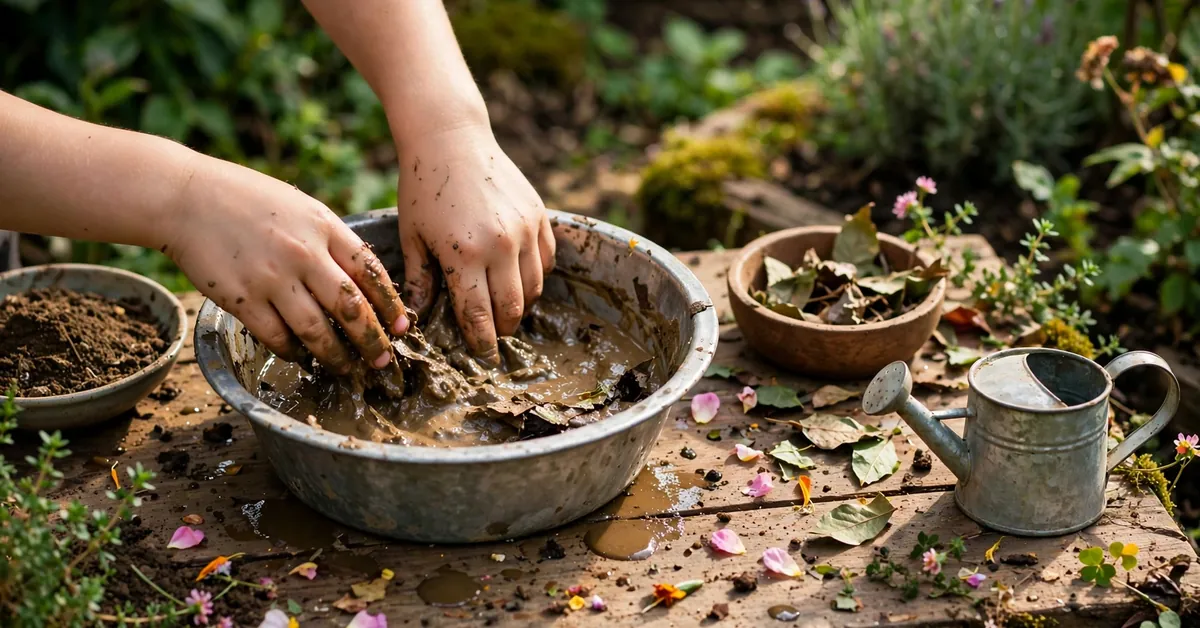
Most parents I know have had the same moment. You spend money on a toy — a good one, the kind with buttons and sounds and a five-star average review — and within a week it is sitting in the corner while your child plays with a stick, a puddle and an old saucepan. It used to puzzle me. Now I think children are telling us something: they are not short of entertainment. They are short of open-ended, hands-on, slightly messy play.
A mud kitchen is really just a corner of the garden set up for that kind of play — a low bench or table, some old pots and spoons, water, soil, and permission to make a glorious mess. It costs very little and asks even less of you. What it gives back, though, is out of all proportion. Here are the ten benefits that keep early-years teachers, and parents like me, coming back to it.
1. Sensory Development
Young children learn about the world through their senses long before they learn about it through words. A mud kitchen is a full sensory workout in one small corner: the grit of dry soil, the smoothness of wet mud, cold water, warm stones, the smell of rain on earth and herbs crushed between small fingers. Each texture and temperature gives the brain new information to sort, compare and remember. This kind of rich sensory input is a foundation of early development — it is how children build the mental categories that later support language and reasoning. Best of all, children seek out exactly the sensations they need, squelching, squeezing and stirring for as long as it holds them.
2. Fine Motor Skills
Nearly everything a child does at a mud kitchen is fine motor practice in disguise. Pinching a leaf to “season” a mud pie, gripping a spoon to stir a thick mixture, unscrewing a lid, squeezing a sponge, pouring from a small jug without spilling — all of it strengthens the small muscles of the hands and fingers and sharpens hand–eye coordination. These are the same muscles and movements children later rely on for holding a pencil, using scissors, doing up buttons and tying shoelaces. Because the practice is wrapped up in play, children repeat it far more willingly than any worksheet — and repetition, done happily and often, is exactly how these skills become strong and automatic.
3. Creativity and Imagination
A plastic toy usually does one thing. Mud does everything. In the space of an afternoon it can be soup, cement, cake batter, a magic potion, medicine for a poorly teddy or the special of the day in a very serious restaurant. Because mud has no fixed purpose, children have to invent one, and that inventing is creativity being exercised. They combine materials, test ideas, tell stories and solve small problems — how do I make this mixture hold its shape? What happens if I add more water? There are no instructions and no wrong answers, which makes a mud kitchen one of the few places in a child’s day where their imagination is entirely in charge.
4. Early Maths Through Pouring and Measuring
Ask a child at a mud kitchen how many spoonfuls fill the little pot, and you are watching early maths happen. Pouring, filling, emptying and comparing containers introduces the big foundational ideas — more and less, full and empty, heavy and light, big enough and not big enough — long before a child meets numbers on paper. They count scoops, share “ingredients” between friends, notice that two small cups fill one big bowl, and begin to estimate: will this jug be enough? Early-years educators call this learning through play, and capacity and measure are among its classic examples. The understanding is physical first, which is precisely why it tends to stick.
5. Early Science: Mixing, States and Cause and Effect
A mud kitchen is a first laboratory. Dry soil plus water becomes mud; mud plus more water becomes slurry; leave it in the sun and it hardens back again. Children observe materials changing state, predict what will happen, test it, and adjust — the bones of scientific thinking, practised with a spoon. They discover which things float, which dissolve, which mixture holds a shape and which collapses, and they learn the deeply satisfying lesson of cause and effect: what I do changes what happens next. Nobody needs to lecture a four-year-old about hypotheses. Give them mud, water and time, and they will run their own experiments all afternoon, then run them again tomorrow to check.
6. Language and Communication
Listen in on a busy mud kitchen and you will hear a remarkable amount of talking. Children narrate what they are making, invent menus, take orders, explain their recipes and argue happily about whose turn it is to stir. All that chat builds vocabulary — words like thick, smooth, pour, sprinkle and delicious get used because they are genuinely needed — and it builds the give-and-take of conversation: asking, answering, describing and listening. For quieter children, talking to a teddy customer or narrating to themselves is a low-pressure way to practise. Play gives children something real to talk about, and children with something real to talk about tend to talk more.
7. Social Skills and Cooperative Play
A mud kitchen is rarely a solo affair for long. Children gravitate to it together, and the play quickly becomes social: one child cooks, another serves, a third arrives as a customer with a pinecone to pay with. To keep the game going they have to negotiate roles, share the good spoon, take turns at the tap and sort out the inevitable disagreements — real social skills, practised in a setting where the stakes are low and the fun is high. Older children often guide younger ones, and younger ones copy everything, which is one of the oldest and best ways children learn. It is cooperative play at its most natural: unscripted, self-organised and different every single day.
8. Emotional Regulation and Calm
There is something about repetitive, absorbing outdoor play that settles children. Scooping, stirring, pouring and patting are rhythmic actions, and children often become noticeably calmer and more focused while doing them — parents regularly tell me the mud kitchen is where their child goes when the day has been too much. Being outdoors, away from screens and indoor noise, helps too. Play like this also gives children a safe place to work through feelings: the “angry soup” gets stirred very hard, the poorly teddy gets better, the scary story gets a happy ending. It is not a cure for big feelings, and nobody should claim otherwise, but as a daily pressure valve it is hard to beat.
9. Physical Activity and Time Outdoors
A mud kitchen will never replace running around, but it quietly adds active time to the day. Children carry buckets of water, haul bags of soil, crouch, stand, reach and dig — the digging alone can keep a determined four-year-old happily occupied for half an hour. Just as importantly, it gives children a reason to be outside in the first place, in daylight and fresh air, across the seasons rather than only on perfect summer days. Time outdoors supports sleep, appetite and general wellbeing, and it builds a easy familiarity with nature: worms, leaves, ice in the water bowl in winter, seedlings in spring. Children who play outside daily tend to treat the garden as another room of the house.
10. Independence and Confidence
In most of a young child’s day, adults set the rules, choose the activity and judge the result. A mud kitchen hands over the keys. The child decides what to make, how to make it and when it is finished. They fetch their own water, find their own ingredients and fix their own mistakes — the tower collapsed, so they build it wetter and shorter. That loop of deciding, trying and succeeding is where confidence actually comes from: not praise, but the experience of “I did that myself.” Because very little can go truly wrong with mud, children take more risks and persist longer. It is often the first place a child plays happily alone, absorbed and self-reliant, while you drink a coffee in peace nearby.
What About the Mess and Germs?
This is the question every parent asks, and it deserves a straight answer rather than a dismissive one. Yes, children will get dirty — that is rather the point — and mud is not sterile. But ordinary garden play has been part of childhood forever, and sensible hygiene keeps the risks where they belong: small.
A few simple habits cover almost everything. Children wash their hands with soap after mud kitchen play, and before eating — make it part of the routine, like hanging up a coat. Use clean water for play and refresh it daily rather than letting the same water sit and stagnate all week; a washing-up bowl you can tip out and refill makes this easy. Keep play soil simple: ordinary garden soil or shop-bought compost, away from anywhere pets toilet. And supervise the youngest toddlers, who explore with their mouths — a child still in the everything-goes-in-the-mouth stage needs you nearby, and some families prefer to start with water and sand until that phase passes.
As for the mess itself: old clothes, an apron if they will tolerate one, and a mat or a defined corner of the garden keep it manageable. Mud washes off children and clothes far more easily than most of us expect. What does not wash off is the play itself — and that is the part they keep.
How to Get the Benefits at Any Budget
None of these benefits depend on buying an expensive play kitchen. A plank across two crates, a washing-up bowl, and a raid on your own kitchen drawer for old spoons, jugs and muffin tins will deliver the same play as a shop-bought setup costing ten times more. Charity shops and thrift stores are full of sturdy metal pots and utensils for pennies, and most families already own everything else they need.
If you would like a little more structure, a simple set of plans helps you build something level and lasting: mud kitchen plans. The classic flat-pack hack is another proven route, turning one well-known stool-and-table combination into a compact kitchen for a small garden: IKEA mud kitchen. And if your setup is built but the play has gone stale, fresh accessories — most of them free or nearly so — change everything: mud kitchen accessories ideas. Start where you are, with what you have. The mud does not mind.
Conclusion
A mud kitchen is not a miracle, and it will not turn every afternoon into a developmental masterclass. Some days your child will make an elaborate three-course mud meal; some days they will just transport water from one end of the garden to the other for reasons known only to them. Both days count. What you are really providing is time, simple materials and the freedom to use them — and the sensory, physical, social and thinking skills follow from that, the way they have always followed from good play.
If you are short of ideas to keep it fresh, start here: mud kitchen ideas. Then step back, put the kettle on, and let the mud do the rest.
Frequently Asked Questions
What age benefits most from a mud kitchen?
Children roughly between 18 months and seven years get the most from a mud kitchen, with the richest imaginative and social play usually happening between ages two and five. Toddlers love the sensory side — pouring, splashing, squelching — while older children run restaurants, build and experiment. Under-twos need close supervision because they explore by mouthing things.
Is mud play hygienic?
With basic habits, yes. Handwashing with soap after play and before eating, clean water refreshed daily, play soil kept away from pet toilet areas, and supervision for mouthing-age toddlers address the real risks. Ordinary garden mud has been part of childhood play for generations; the aim is sensible hygiene, not sterility.
How often should children play at a mud kitchen?
There is no required dose. Little and often works well — even twenty minutes a few times a week builds skills and habits — but many children will happily play daily when the kitchen is simply left set up and accessible. Leaving it ready to go, rather than making it a special occasion, is what turns occasional fun into a routine.
Do I need a big garden for a mud kitchen?
No. A mud kitchen can be a single bench, a bowl and a bucket on a balcony, patio or tiny yard. Small setups still deliver pouring, mixing and imaginative play; you just scale the amounts down. A water container with a tap or jug keeps even a balcony version tidy and easy to refresh.