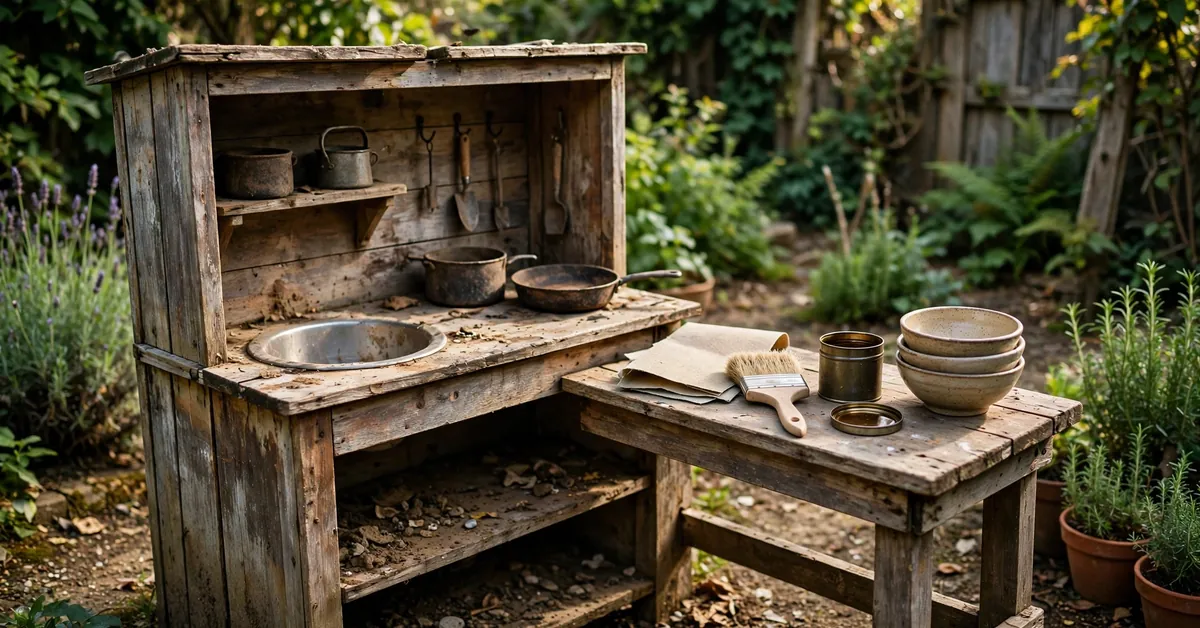
Every spring, the same quiet event happens on local selling groups across three countries: families whose children have turned seven list their mud kitchens. A wooden kitchen that cost $150 / £120 new appears at $40 / £30, sometimes barely used, often with a crate of utensils thrown in because the seller wants the garage space more than the money. Meanwhile, other families are paying full price for the same kitchen, new, in a box. This guide is for the first group’s buyers: where the good ones appear, the ten-minute inspection that separates a bargain from a bonfire, what you should actually pay, and the half-day refresh that makes a used kitchen honestly giftable — or simply yours.
I write this as someone whose own favourite kitchen began life as somebody else’s garden furniture. Second-hand is not the compromise version of a mud kitchen. Done with your eyes open, it’s the smart version.
Where the Good Ones Appear (and When)
- Local selling groups and marketplace listings are the main market, and the calendar runs in your favour twice a year: autumn clear-outs (September–November, when families reclaim gardens) and the spring upgrade wave (March–May, when last year’s outgrown model funds this year’s bigger one). Autumn prices run lower; spring choice runs wider.
- What to search: “mud kitchen”, but also “potting bench”, “play kitchen outdoor”, and “wooden kitchen” — mislabelled listings are where the bargains hide, because a potting bench is a mud kitchen awaiting conversion and sellers price it as garden furniture.
- Move quickly on the good ones. A sound wooden kitchen at a fair price in spring is measured in days, sometimes hours. Set the alert, have the car space ready, and don’t negotiate by message for a week over $10 — someone else is driving over tonight.
The Ten-Minute Inspection (Do This at the Seller’s Gate)
Bring a phone torch and no embarrassment. You are checking the four things that kill wooden kitchens, in order:
- The feet. This is where mud kitchens die. Crouch down and press the bottom of each leg with your thumb, hard. Sound wood doesn’t dent. Soft, dark, crumbly wood — rot — means that leg is finished, and a kitchen with rot in two or more legs is firewood with accessories. One rotten leg on an otherwise sound kitchen is a repair (legs are cheap to replace), and a legitimate negotiating point.
- The rock test. Push the frame firmly from the side and the front. A slight flex in a light frame is normal; a racking wobble that tightening won’t cure means the joints have gone — and joints are the kitchen. Walk away from a wobbler unless it’s nearly free and you’re handy.
- The worktop. Splinters and weathering sand out in twenty minutes; a worktop that is soft, warped into a pond, or split along the grain does not. Run your palm over it — you’ll find in five seconds what your eyes miss.
- The inventory. All panels present? Sink bowl? Hooks, shelves, the fixings bag if it’s somehow still flat-packed? A missing sink bowl costs $5 / £4 to replace; a missing structural panel costs the kitchen. Price the small stuff in, walk from the big stuff.
And ask the one question sellers answer honestly because it costs them nothing: “Where has it been standing?” A kitchen that lived on a patio under a cover and a kitchen that stood in wet grass for three winters are the same age and different objects. Grass-standing is not a deal-breaker — it’s a price.
What You Should Actually Pay
Against new prices of $50–$150 / £40–£120 for a solid wooden kitchen (the current models are compared in my best outdoor mud kitchen for kids roundup):
- Like-new, one season, patio-kept: half to two-thirds of new. Fair, and still a bargain, because year one is when a kitchen loses money fastest.
- Sound but weathered — grey wood, needs oil, all there: a third to a half of new. This is the sweet spot; an afternoon’s refresh returns it to the first category visually.
- One fixable fault (a leg, a bowl, a hinge): price it as the category below and mention the fault by name. Sellers respect a buyer who has clearly inspected.
- Rot in two legs, racking frame, soft worktop: free to $15 / £10, for the sink, hooks and hardware — which are, not coincidentally, the expensive bits to buy new. Salvage is a legitimate purchase; just don’t call what follows a bargain kitchen, call it a parts donor.
The Refresh: Half a Day Between Their Garden and Yours
A second-hand kitchen should never go straight into service, for hygiene as much as pride. The routine is the front half of my mud kitchen maintenance guide, done once, thoroughly:
- Scrub everything — frame, worktop, sink, every utensil — with a stiff brush, warm water and washing-up liquid; a vinegar solution on green algae patches. Hose, then dry in full sun, which is doing quiet disinfecting work of its own.
- Sand the contact surfaces — worktop, edges, handles — with 120-grit, until your palm finds nothing. This is also when you learn the kitchen properly: every fixing gets looked at, tightened, or replaced with stainless.
- Run the safety pass exactly as you would on your own kitchen: the standing rules are in my mud kitchen safety checklist — protruding screws, finger-trap lids, stability shove, and fresh soil of known origin in a lidded tub rather than whatever mystery mix arrives free with the purchase. Empty any water containers it came with and start the fresh-water rule from day one.
- Oil it. One coat of child-safe exterior oil (check the tin says suitable for play equipment once cured), and the grey, tired wood comes back to colour in a way that still surprises me. Cure fully before the chefs arrive.
Total refresh cost: an oil tin you’ll use for years and $0–$10 / £0–£8 of hardware. Total time: half a day, with drying. The result photographs like the first price category at the third category’s money.
The Gift Angle, Briefly
A refreshed second-hand kitchen is a genuinely good gift — wooden, personal, and (if you did the refresh properly) indistinguishable from new to the only critic who matters, who is four. If it’s going to another household, the checks a gift-buyer runs are in my mud kitchen gift guide — ask the parents first, know the space — and a used kitchen adds one virtue of its own: you can deliver it built, which solves the flat-pack-on-Christmas-Eve problem at a stroke.
A Word on Potting Benches (the Mislabelled Bargains)
One category of listing deserves its own paragraph, because the sellers don’t know what they’re selling. A solid timber potting bench — worktop, lower shelf, back uprights — is a mud kitchen one conversion away: the legs cut down to child height, a washing-up bowl dropped in as the sink, hooks on the back rail. The full method is in my potting bench mud kitchen conversion guide. Sellers price benches as garden furniture ($30–$60 / £25–£50, often less in autumn), which means a converted bench frequently lands you a wider, sturdier kitchen than the same money buys in anything labelled “mud kitchen” — the word mud apparently carries a premium now. Run the same inspection: feet first, thumb test, rock test. Benches have one extra check — the worktop slats. You want slats you can lift or a top you don’t mind cutting; a bench whose top is a single fixed sheet of mesh is the one variant to leave behind.
FAQs
Is it safe to buy a second-hand mud kitchen?
Yes, with a refresh before first use. Scrub everything, sand the contact surfaces smooth, tighten or replace fixings, empty and clean any water containers, and start with fresh soil of known origin in a lidded tub rather than soil that arrives with the kitchen. The structural checks matter more than the hygiene ones: rot in the feet and a racking frame are the real reasons to walk away.
How much should a used mud kitchen cost?
Roughly: half to two-thirds of the new price for a one-season, patio-kept kitchen; a third to a half for a sound but weathered one; and near-free for anything with rot in two or more legs or a frame that racks — which is worth buying only as a parts donor for its sink, hooks and hardware. Against new prices of $50–$150 / £40–£120, most good used kitchens change hands at $25–$70 / £20–£55.
What should I check before buying a used mud kitchen?
Four things, in order. The feet: press each leg with your thumb — soft, dark wood is rot, and two rotten legs ends the conversation. The frame: a hard push from the side — racking that tightening won’t fix means walk away. The worktop: your palm finds splinters and soft spots your eyes miss. The inventory: sink bowl, panels, shelves — small missing parts are cheap, missing structure is not. And ask where it stood: patio-kept and grass-kept kitchens age at different speeds.
When is the best time to buy a second-hand mud kitchen?
Autumn (September–November) for price — families clearing gardens list cheap and negotiate kindly. Spring (March–May) for choice — the upgrade wave puts the widest range on the market, but good ones go in days, so set listing alerts and be ready to collect the same evening. Winter listings are rare and usually the cheapest of the year if your storage can take one until March.
Can you give a second-hand mud kitchen as a gift?
Yes — it’s one of the better gift routes in this niche. Do the full refresh (scrub, sand, safety pass, a coat of oil), and it presents as a handsome wooden kitchen, delivered already built, which quietly solves the flat-pack assembly problem that catches so many gift-buyers. Be honest with the parents that it’s a refreshed pre-loved kitchen if they ask; don’t volunteer an apology for it. Children have never once asked about provenance.