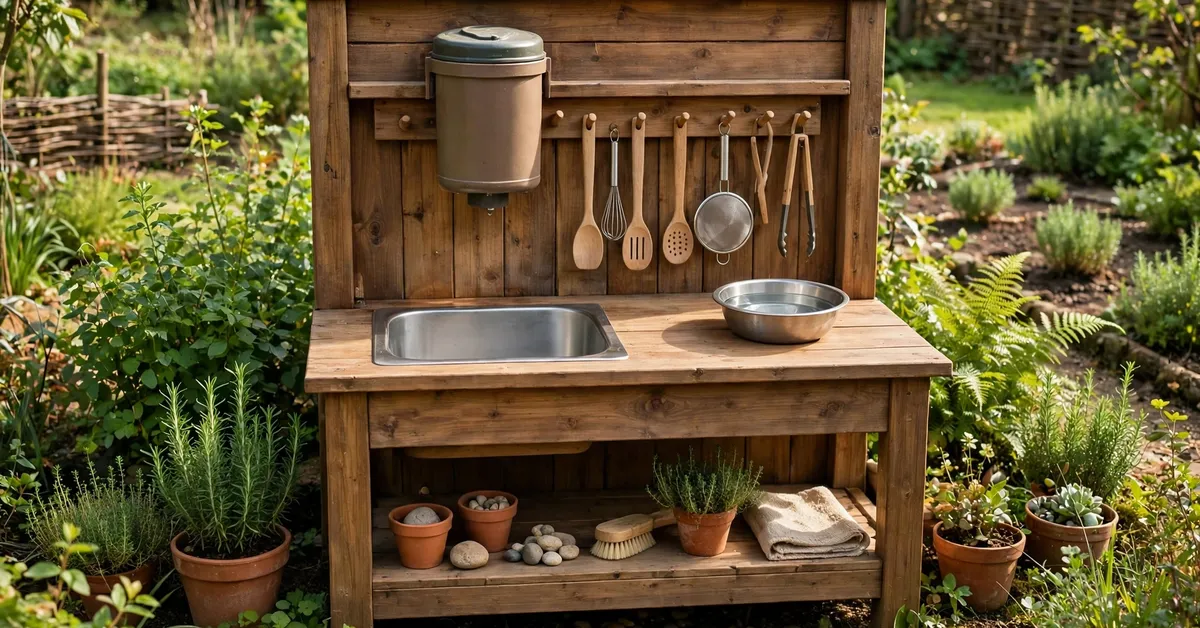
Mud is not sterile, and that’s rather the point of it — but “not sterile” is not the same as “anything goes”. A mud kitchen needs a handful of sensible habits, not a hygiene regime. Get these right and mud play becomes one of the easiest yeses in the garden: cheap, absorbing, outdoors, and about as risky as the rest of childhood done properly.
This is the checklist I actually run at our house, organised the way the risks actually occur — water, soil, the structure itself, sun, and supervision by age. It’s calm because the reality is calm: in years of mud kitchen play, our complete injury list is one splinter and a stubbed toe. The habits below are why the list is that short.
Water Hygiene: The One Rule That Matters Most
Empty everything at the end of the session, and start with fresh water next time. That’s the rule; everything else is detail.
Standing water is the mud kitchen’s one genuine hygiene issue. A bowl of water left in warm weather grows bacteria fast, breeds a film within a day or two, and invites mosquitoes to lay eggs in it. Children dip hands, cups and occasionally faces in that water. Yesterday’s water is the difference between “muddy” and “actually unhygienic”.
The routine that works:
- Tip out bowls, buckets and the sink at tidy-up time — onto a flower bed or the base of a tree, where it’s useful. Upside-down containers can’t refill with rain.
- Tap containers and reservoirs: empty what’s left rather than topping up indefinitely, and scrub the inside with a bottle brush every week or two in summer. A musty smell means it was overdue.
- Tubing and pumps: a green tinge means algae — flush with clean water, and drain pumps before storing them.
- Never leave open water containers standing as a habit — for hygiene, for mosquitoes, and because any container of water deserves respect around the smallest children (see supervision, below).
Soil Safety: What’s Actually in the Mud
Garden soil is mostly harmless — it’s what gardens are. Three specific things are worth a thought:
Know your soil’s history
If your house is old (pre-1970s paint, industrial history nearby) or the garden was ever a dumping spot, soil can carry lead or contaminants that no amount of hand-washing fully answers. This is uncommon, but it’s the one case where I’d change the setup: use a raised kitchen with bought topsoil or compost in a contained bed or large tub instead of ground soil, so you know exactly what’s in the mix. A bag of topsoil costs about $5 / £4 — cheap certainty. The same trick solves stony, rubble-filled or pure-clay gardens.
Animal fouling
Cats use loose soil and sand as a litter tray; dogs are less subtle. Cat faeces can carry toxoplasma, and this — not mud itself — is the strongest argument in this whole article for hand-washing. Practical steps:
- Cover the play soil, sand and the kitchen’s ingredient tubs at night (a board, a lid, a tarp). A covered sandpit-style setup removes most of the risk entirely.
- Check the patch before sessions — a ten-second glance while you fill the water.
- Fence or net the area if cats are persistent. Our solution was boring and total: the mud supply lives in a lidded tub, not an open bed. Problem solved permanently for the price of a tub.
Gloves: when and when not
For ordinary garden soil and mud, bare hands are fine and rather the point — children need the sensory feedback, and hand-washing afterwards handles the rest. Reach for gloves when: handling compost or manure-based mixes, clearing an area you suspect cats have used, or dealing with any soil of unknown history. Thin gardening gloves for the child, real ones for the adult doing the mucky setup jobs.
Plants and berries
Teach one bright-line rule early: nothing from the mud kitchen goes in mouths, and no berries, mushrooms or leaves get picked without an adult saying yes. Most garden plants are harmless, but a few common ones (foxglove, laburnum, yew, some berries) are genuinely toxic, and small children collect first and ask later. Keep the kitchen’s ingredient zone stocked from parts of the garden you know, and walk the patch once for anything suspect.
The Structure: Splinters, Stability and Sharp Edges
A wooden kitchen outdoors weathers, and weathered wood needs a five-minute check each season:
- Splinters: run your palm (adult palm — find them yourself, not via a small hand) over the worktop, shelf edges and handles. A rub with 120-grit sandpaper fixes rough patches in minutes; a coat of child-safe exterior oil or paint each year slows it coming back. Pallet wood needs this most — check every board edge at build and twice a year after.
- Stability: push the kitchen hard from the side and front. It should rock at most a fraction. Bolt or stake a wobbly frame, keep heavy water containers low or centred over the legs, and never let children climb or sit on the worktop — say it as a standing rule, because they will test it.
- Screws, nails and fixings: weather works screws loose and wood shrinks around them. Check for anything protruding — a proud screw head on a worktop edge is a scratch waiting to happen — and tighten or replace as you find them.
- Hinges and lids: oven doors and lidded storage are finger traps. Choose soft-close or simple drop-in lids, and check that a lid can’t slam. Our oven door came off entirely in year two and nobody has missed it.
- Bought kitchens: check the fixings after the first month outdoors (weather moves new wood most), and confirm any “outdoor” paint or finish is genuinely weatherproof rather than decorative.
Utensils and Equipment Safety
Brief, because the list is short: no glass, no ceramic, nothing electrical, nothing that held chemicals, no real knives or sharp tools, no heavy cast iron a small cook could drop on a foot. Big, blunt, light and unbreakable is the standard. The age-specific version — mouthing, small parts, what under-threes need — is covered fully in my mud kitchen for toddlers guide; if your chef is under three, read that one first.
Sun, Shade and Weather
- Shade for sessions, not just storage. A kitchen in afternoon shade gets longer, happier sessions in summer. If yours stands in sun, a shade sail or a rule about morning play in hot months does the job.
- Sunscreen and a hat are part of the setup, because a child deep in a café storyline will not come in to be reminded. Apply before the session; keep a hat that lives at the kitchen.
- Water warms up. A black container in full sun can hold surprisingly hot water by mid-afternoon — check with your own hand before small hands go in.
- After heavy rain: tip out everything that filled, check the standing patch for slipperiness, and expect the ground in front of the kitchen to be at its slickest. Bark or pavers earn their keep on exactly these days.
Supervision, Age by Age
Mud kitchen supervision is about proximity, not hovering. Honest guide:
- Under 2: arm’s reach, always. Water is shallow (a few centimetres in a bowl, not a bucket), ingredients are big, and everything will be mouthed — so everything must be mouth-safe. Short sessions, constant presence.
- Ages 2–3: an adult in sight and earshot, in the garden or at the window. Buckets get emptied at tidy-up without negotiation, and the no-eating rule gets cheerfully repeated about four hundred times.
- Ages 4–5: garden independence for most children — an adult in the house with the kitchen in view, checking in. This is the age of elaborate unsupervised storylines; your job is water freshness and the odd dispute over the good whisk.
- 6 and up: they’re running a business now. Periodic checks, the hygiene habits as their own responsibility (empty, wash, cover), and an adult on call for structural repairs and café complaints.
Under-threes and any depth of water is the combination to respect most: it is never the mud that worries me, it’s a toddler, a full bucket and thirty unsupervised seconds. Shallow bowls and emptied buckets remove the issue at the root.
The Cleaning Routine (Five Minutes, Weekly-ish)
- Scrub the sink bowl and main utensils with a brush, warm water and washing-up liquid; rinse. Slime is a schedule problem, not a product problem.
- Empty, scrub and dry the water container every one to two weeks in summer.
- Wash or replace cloth items — the café tea towel and any fabric bunting — before they go musty.
- Sweep the standing patch and check for anything sharp that’s migrated in (stones are fine; the occasional screw from a DIY project is not).
- Restock and cover: lids on the dry tubs, kitchen covered or containers inverted, ready for tomorrow.
None of this is meant to make mud play sound like a laboratory. The whole reason families love these kitchens — the development case, from sensory play to early science — is set out in my benefits of a mud kitchen post, and it’s a strong one. These habits exist so the benefits come without the avoidable nonsense: fresh water, washed hands, a structure that doesn’t wobble, and an adult somewhere in the vicinity. That’s genuinely all of it.
FAQs
Is playing in mud actually safe for children?
Yes, with basic habits. Ordinary garden soil, fresh water, hand-washing afterwards and supervision matched to age make mud play a low-risk activity — comparable to gardening itself. The specific things to manage are standing water (empty it daily), animal fouling (cover play soil and wash hands), and knowing your soil if your property has an industrial or very old-paint history (use bought topsoil if in doubt).
How often should I change the water in a mud kitchen?
Every session. Tip out bowls and containers at tidy-up time and refill fresh next time — standing water grows bacteria quickly in warm weather, attracts mosquitoes, and is the one real hygiene risk in a mud kitchen. Scrub containers every week or two in summer.
Should my child wear gloves in the mud kitchen?
Not for ordinary mud play — bare hands are part of the point, and hand-washing afterwards does the job. Use gloves for compost or manure mixes, for clearing ground cats may have used, or for soil of unknown history. And if your soil’s history is a real concern, switch the mud supply to bought topsoil in a lidded tub and the worry mostly evaporates.
What age can a child use a mud kitchen unsupervised?
“In sight of an adult” is the standard until about four. From four to five, most children play happily with an adult in the house and the kitchen in view. True independence comes around six — but the hygiene habits (empty the water, wash hands, cover the tubs) should become the child’s own job from whenever they can do them, usually earlier than parents expect.
How do I stop cats using the mud kitchen area as a litter tray?
Cover everything loose: lidded tubs for soil and sand (this alone solved it for us), a board or tarp over any open bed at night, and a quick check of the patch before sessions. If cats persist, netting or fencing the kitchen corner is the permanent fix. And it’s one more reason the hand-washing rule is non-negotiable.