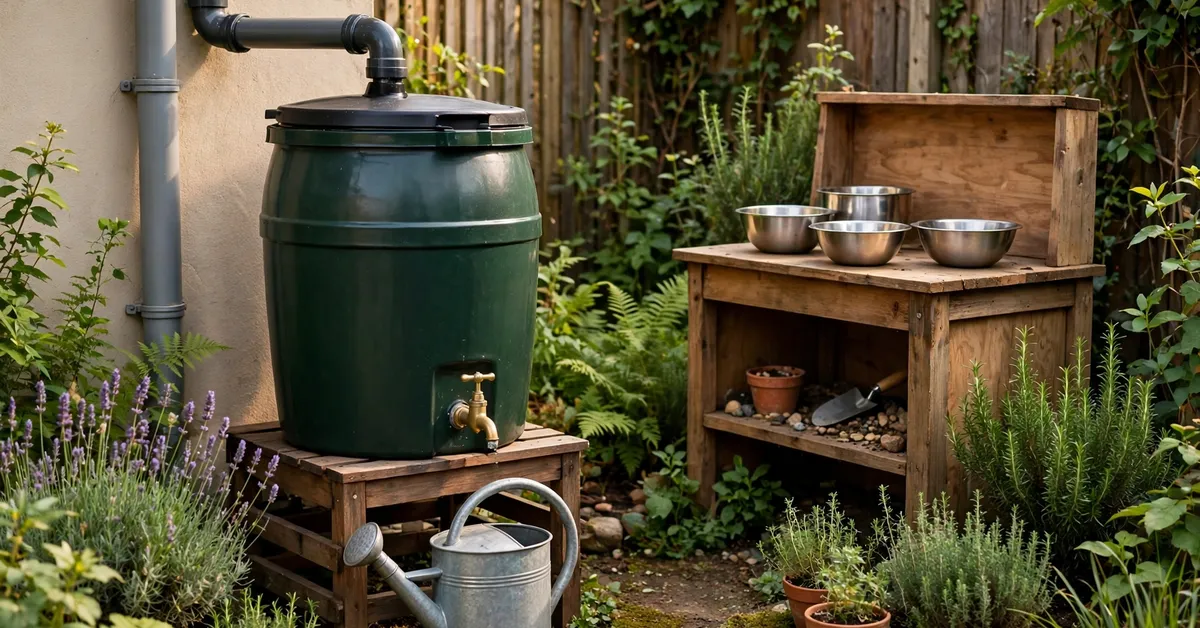
A mud kitchen in full summer service is a thirsty thing. Between the café, the potion station and the perpetual washing-up, a busy session works through bucket after bucket — and every one of them is carried, by an adult, from the kitchen tap. A water butt beside the mud kitchen ends the carrying. It fills itself from the roof all winter and spring, stands within arm’s reach of the worktop, and puts rainwater effectively on tap at exactly the height and exactly the place the play happens. Ours went in as a convenience and stayed as infrastructure: the single change that most reduced adult labour in the whole mud kitchen setup, and the one I’d install first if I were starting again.
Why Rainwater Suits a Mud Kitchen So Well
Start with the fit. Mud kitchen water is not drinking water — it’s mixing water, pouring water, washing-down water — and it is used in volumes the garden tap supplies expensively and the roof supplies free. A standard house roof in the UK or the wetter US states sheds thousands of litres a year; a mud kitchen’s whole season runs on a few hundred. The butt also solves the summer problem: hosepipe restrictions and dry spells arrive in exactly the weeks mud play peaks, and a full butt is a private reservoir that doesn’t care. In Australia, where summer water restrictions are a fact of life, it’s often the difference between a mud kitchen in service and one standing dry — the waterwise logic runs through my southern hemisphere mud kitchen guide too.
There’s a quieter benefit. Children understand a water butt in a way they never understand a tap: you can see the level fall. Rain in, play out, empty by August if the sky doesn’t help — the water cycle stops being a school diagram and becomes the café’s supply problem, and rationing the last butt of water in a dry week is some of the best practical maths our kitchen has ever taught.
Choosing and Placing the Butt
Size first: 100–200 litres (25–50 gallons) is the mud kitchen sweet spot. Smaller butts empty in a weekend of café service; bigger ones are worth it only if the garden shares the supply. What matters more than size:
- A proper lid, always. Non-negotiable, for child safety and for water quality — an open butt is a hazard and a mosquito farm. This is the top of the list in my mud kitchen safety checklist thinking: the butt is lidded, full stop.
- Dark or opaque plastic. Light grows algae; a dark butt keeps the water noticeably fresher.
- Height. Stand the butt on a proper stand or a solid stack of blocks so the tap clears a watering can or bucket beneath it — gravity is your pump, and every centimetre of height is pressure. The stand must be level and immovable; a full 200-litre butt weighs 200 kilos.
- Position. Close to the kitchen (the whole point), fed by the nearest downpipe via a diverter kit, and sited with the overflow in mind: when the butt is full, the excess has to go somewhere deliberate — a flowerbed or drain, not the kitchen’s foundations. The general siting principles are in my mud kitchen setup guide; the butt joins the layout as a fixed point, not an afterthought.
Getting the Water Out at Child Height
A standard butt tap sits near the bottom, which is right for filling cans and wrong for small chefs. Three ways to serve the kitchen itself, in order of effort:
- The watering-can relay. Tap at the butt, can carried two steps, kitchen stocked. For toddlers this is the play — the carrying is the job they want most. Zero plumbing, zero failure modes.
- A short hose to the kitchen’s container. Butt tap to the worktop’s water container by gravity, if the butt stands higher than the container — the arrangement in my mud kitchen with working tap guide, with the butt replacing the header supply. Keep the run short and the hose food-safe.
- A hand pump on the butt. For households that want water delivered without carrying at all, the pump options from my mud kitchen with water pump post fit a butt exactly as they fit a container — and pumping is, again, a job children queue for.
Whichever route: fit a simple inline tap or kink the hose at the kitchen end, because a slow gravity leak will silently empty a butt in a week, and you’ll blame the weather.
The Hygiene Rules (Short, and Not Optional)
Rainwater off a roof is garden water, and it gets garden-water rules, applied without exception:
- Lid on, mesh on. The lid stays on except when filling a can; a mesh screen under the diverter keeps leaves and worse out of the water. Both together are also the entire mosquito strategy — no access, no breeding.
- Play water, never drinking water. The butt is for mixing, pouring and washing down. Hands get washed in clean water before food, exactly as at every other water setup on this site. Children old enough for the kitchen are old enough for “the butt is not a drink” as a house law.
- Don’t store play water in open containers. Water drawn from the butt into the kitchen’s containers follows the same fresh-daily rule as any standing water — drawn in the morning, tipped away at the end of play, never left to stand green between sessions.
- A scrub once or twice a year. Empty the butt in a dry spell, scrub the sediment out, rinse, and reconnect — it folds into the spring session of the mud kitchen maintenance routine and takes twenty minutes.
- Flush the first rain after a dry spell. The first roof-wash after weeks of dust, pollen and bird contributions is the dirtiest water the butt will ever catch. Many diverter kits include a first-flush setting for exactly this; without one, the honest version is to draw off and discard the first canful or two onto the flowerbeds after a long dry spell before the kitchen takes its share. Thirty seconds of scepticism, once a month or so, keeps the whole supply noticeably cleaner.
Winter, Dry Spells and Other Weather
The butt’s calendar runs opposite to the kitchen’s. In freezing winters, open the tap and drain the butt down before hard frost: water expands as it freezes, and a full butt in a cold snap can split at the seams. In mild climates it can stay in service all year, guarded by the lid as usual. In dry spells, the discipline the children learn is real rationing; when the butt does run dry, top up from the tap without ceremony — rain is the main supply, not a religion — and take the weather’s hint from my mud kitchen in the rain post, which is when the butt earns its keep fastest: one good storm refills what a month of play used.
What It Costs, Honestly
A 200-litre butt with lid, tap and stand runs $50–$100 / £40–£80, a downpipe diverter kit $15–$30 / £10–£25 — call it under $130 / £105 installed in an afternoon. Now the honesty: on water bills alone, at mud-kitchen volumes, it may take years to pay back, and in cheap-water areas it may never fully do so. That is not why you install it. You install it for the end of the bucket-carrying, for service through hosepipe bans and dry weeks, and for a water supply children can see, measure and learn to ration. Priced as convenience and resilience, it’s cheap. Priced as a money-saving gadget, don’t let anyone sell it to you on that basis — me included.
FAQs
Is rainwater from a water butt safe for mud kitchen play?
For mixing, pouring and washing down — yes, with the standard rules: the butt stays lidded with a mesh screen, the water is drawn fresh for each session and tipped away afterwards, and it is never drunk. Hands are washed in clean tap water before food, as with every mud kitchen water setup. The risks with stored rainwater are all about storage — open, sunlit, stagnant — and the lidded dark butt with fresh-drawn water is precisely how you avoid them.
What size water butt do I need for a mud kitchen?
100–200 litres (25–50 gallons) covers a busy home mud kitchen comfortably — roughly a month of regular sessions in a dry spell, refilled continuously in normal weather. Go to the top of that range if the garden shares the butt or your summers are long and dry. Bigger matters less than position and height: a 150-litre butt on a stand beside the kitchen beats a 300-litre one at the far end of the garden.
How do I stop mosquitoes breeding in the water butt?
Deny access and there’s nothing to stop: a fitted lid that stays on, plus a fine mesh screen where the downpipe diverter enters. Mosquitoes need to reach the water’s surface to lay; a sealed, dark butt gives them no route in. If a butt has stood open and larvae are present, empty it completely, scrub, and start again lidded — no chemicals near a children’s play supply, ever.
Can a water butt feed a mud kitchen tap?
Yes — by gravity, if the butt tap sits higher than the kitchen container it feeds, via a short food-safe hose; the butt simply becomes the header tank for the container-tap arrangement. Keep the run short, and fit a tap at the kitchen end, because a slow leak will drain a butt in days. Where the heights don’t work, a hand pump on the butt does the same job with more entertainment value.
Do I need to empty the water butt in winter?
In climates with hard frosts, yes — drain it down and leave the tap open before the coldest weeks, because freezing water expands and can split the butt at the seams. In mild climates it can stay in service year-round with the lid on. Either way, give it its scrub in a dry spell once or twice a year; sediment builds up quietly and spring is the natural moment, just before the season starts.