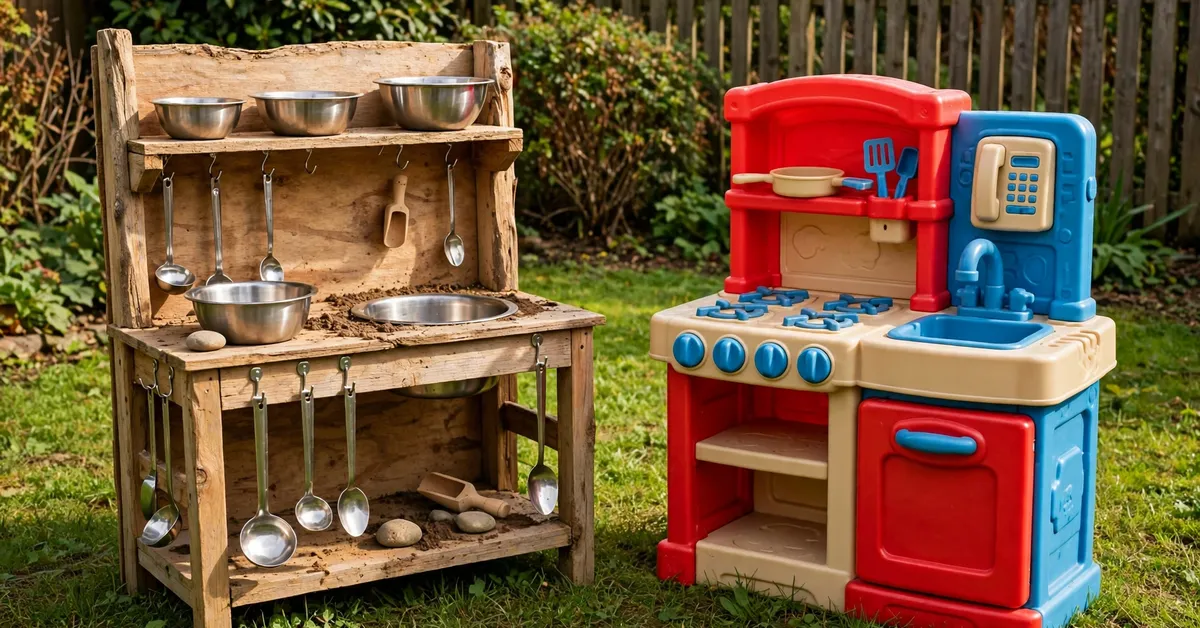
Every mud kitchen buying decision eventually narrows to this fork: the wooden kitchen that looks like garden furniture, or the bright plastic one from the toy aisle that costs less and hoses clean in a minute. Parents argue it with surprising passion, usually along tribal lines — wood people call plastic flimsy, plastic people call wood a maintenance hobby. Both are half right, which is unhelpful if you’re the one spending the money. This is the honest comparison, from a household that has run both into the ground: what each material actually does across a whole childhood of weather, water and enthusiastic small chefs — and which families should buy which, without apology either way.
The Short Version
If you want it in one paragraph: wooden wins on lifespan, stability, play value and resale; plastic wins on price, weight and zero upkeep. A decent wooden kitchen, oiled once a year, will serve two or three children and still sell second-hand afterwards. A plastic kitchen will serve one childhood cheerfully, ask nothing of you, and be worth almost nothing at the end of it — but it will also survive being ignored in a way wood won’t. The rest of this post is the detail behind that paragraph, because the right answer depends on which kind of family you honestly are.
Durability and Weather: The Real Difference
Wood’s weakness is water sitting where it shouldn’t. Neglected — feet in wet grass, never oiled, bowls left full — a wooden kitchen rots at the feet and greys at the worktop within a few seasons. Maintained with the annual routine in my mud kitchen maintenance guide, the same kitchen runs a decade: oil it, keep the feet dry, and wood’s failures are nearly all preventable. Wood’s great strength is that it can be repaired — a split board replaced, a wobbly leg re-fixed, a tired surface transformed by the finishes in my how to paint a mud kitchen guide.
Plastic’s weakness is the sun. UV makes it fade, chalk and eventually crack, and a cracked plastic kitchen is finished — there is no repair, no refinishing, only replacement. But within its lifespan it is gloriously indifferent: rain, frost, mud, neglect, it does not care. Expect three to five good years from a decent plastic kitchen left outside, longer if it winters under cover — against wood’s decade-plus with care, or wood’s two-to-three years without any. Note the honest asymmetry: plastic tolerates neglect; wood rewards care. Choose for the owner you actually are.
There’s a subtler difference in how the two materials age, and it matters if you care how the garden looks in year three. Wood wears visibly but honestly: it silvers, darkens where hands and water land, and a coat of oil resets most of it in an afternoon — the kitchen looks its age and then, once a year, looks nearly new again. Plastic fades unevenly — the red tap goes pink, the sunny side chalks first, stickers peel into ghosts of themselves — and none of it can be reversed, only lived with. Neither trajectory is a scandal, but a wooden kitchen in year six, freshly oiled, is a piece of garden furniture; a plastic kitchen in year six is a toy that has survived, and visitors can tell the difference at a glance. If the kitchen will live somewhere prominent — and mud kitchens usually do — that difference is worth real money to some families and nothing at all to others.
Play Value: Weight Is a Feature
Here is the difference nobody mentions in the shop. A wooden worktop stays where you put it. Bowls don’t skate, the whole structure doesn’t creep across the patio under enthusiastic stirring, and real metal tools — the ones from my what to put in a mud kitchen list — feel right against it. Wood also accepts modification: hooks screwed where you need them, a shelf added, a sink bowl cut in, a second station built on as siblings arrive. The kitchen grows with the child because it’s joinery, not a moulding.
Plastic kitchens come with their features pre-decided: moulded hob rings, a fixed pretend tap, clicky knobs. For a two-year-old that built-in theatre is genuinely delightful, and the lightness is a real advantage — a plastic kitchen can be carried to the shade, the garage, or a grandparent’s car boot in a way no wooden unit allows. The trade is that the play is scripted by the mould, and when a moulded part snaps, the feature is gone. Young toddlers often prefer the plastic one. Older children almost always migrate to the wood.
Safety and Cleaning
Both are safe when chosen and sited properly, and both have one characteristic failure to check. Wood: splinters on worn surfaces (a palm-check and a sand is the fix, and the finishes in the painting guide are toy-safe EN 71-3 products) and stability — a heavy wooden kitchen that passes the shove test in my mud kitchen safety checklist is close to untippable. Plastic: sharp edges where UV-brittle plastic has cracked, and lightness — a small plastic kitchen can tip or slide under a climbing toddler, so it wants a level surface and supervision like anything else.
Cleaning splits the other way. Plastic hoses down in seconds and forgives a fortnight of dried mud. Wood wants the mud hosed or brushed off reasonably promptly and its containers emptied, because damp held against wood is how the rot clock starts. If your honest routine is “deal with it in September”, plastic is your material and there’s no shame in knowing it.
Cost Over a Whole Childhood
Up front, plastic is cheaper: roughly $40–$90 / £30–£70 for the big toy-brand kitchens, against $50–$150 / £40–£120 for solid wooden models (the current wooden field is compared in my best outdoor mud kitchen for kids roundup). But mud kitchens are rarely a one-child purchase across a family’s life, and the arithmetic changes over time:
- Wooden: buy once at, say, $110, oil at a few dollars a year, serve two or three children over eight-plus years, then sell it on — sound wooden kitchens change hands at a third to half of new price, as the price bands in my second-hand mud kitchen guide show. Net cost of ownership can end up remarkably small.
- Plastic: buy at $60, replace once when it cracks or is outgrown at around year four, sell neither. Two purchases, zero resale, and the second one is rarely loved like the first.
Per year of service, cared-for wood is usually the cheaper kitchen. Per hour of your attention, plastic wins by a distance. Both currencies are real; spend the one you have more of.
Which One Suits Your Family?
- Buy wooden if the kitchen has a permanent home in your garden, there’s more than one child (or more coming), you like the idea of adapting and extending it, and an hour with a tin of oil once a year sounds pleasant rather than like a threat.
- Buy plastic if you rent or move often, the kitchen must travel (plastic is the natural partner to the travel kit in my portable mud kitchen post), upkeep will genuinely never happen, or the child is two and you want a cheap test of whether mud play takes at all before committing.
- Buy second-hand wooden if you want the wooden answer at the plastic price — it’s the route I’d steer most families to, and the checks take ten minutes.
And if it’s a gift, the considerations in my mud kitchen gift guide apply to both materials — buy for the garden and the parents it will actually live with, not the photograph. A plastic kitchen handed to a wood-maintaining family will be outgrown politely; a heavy wooden unit handed to a family in a second-floor flat will be resented by August, however beautiful it looked in the listing.
FAQs
Is a wooden or plastic mud kitchen better?
Better at different things. Wooden is better for lifespan, stability, open-ended play, adaptability and resale — a cared-for wooden kitchen can serve a whole family’s childhoods and still sell on. Plastic is better for upfront price, portability and total indifference to neglect. For a permanent garden setup with more than one child, wooden wins on the evidence; for renters, travellers and the cheerfully low-maintenance, plastic is the honest choice.
Do plastic mud kitchens last outdoors?
A decent one gives three to five good years outside before UV fading and brittleness set in; storing it under cover or in a garage over winter stretches that noticeably. What plastic won’t survive is being climbed on once it’s gone brittle — check older plastic kitchens for cracks and sharp edges each spring, and retire them when the plastic starts to feel chalky.
Are wooden mud kitchens safe for toddlers?
Yes, with the standard checks: a stable unit that passes a firm shove test, smooth sanded surfaces, fresh water daily and soil of known origin. Weight is on wood’s side here — a small wooden kitchen is much harder for a toddler to tip or drag than a light plastic one. Heights and the full toddler setup are in my mud kitchen for toddlers guide.
Can you leave a wooden mud kitchen outside all year?
Yes — that’s what it’s built for, provided the basics are in place: feet up on slabs or gravel out of standing water, containers emptied, and an annual coat of exterior oil. The kitchens that die young outdoors are the ones standing in wet grass and never oiled. Under cover in the worst of winter it lasts longer still, but a wooden kitchen that needs bringing indoors isn’t a wooden kitchen, it’s furniture.
Which is better value, wooden or plastic?
Over one childhood, cared-for wood: one purchase, pennies a year in oil, and real resale value at the end. Over a short horizon — one toddler, a move coming, no maintenance likely — plastic’s low upfront price is better value because you’ll never pay the replacement cost inside your window. The worst value of all is the expensive wooden kitchen bought by a family that will never oil it; buy for the owner you are.