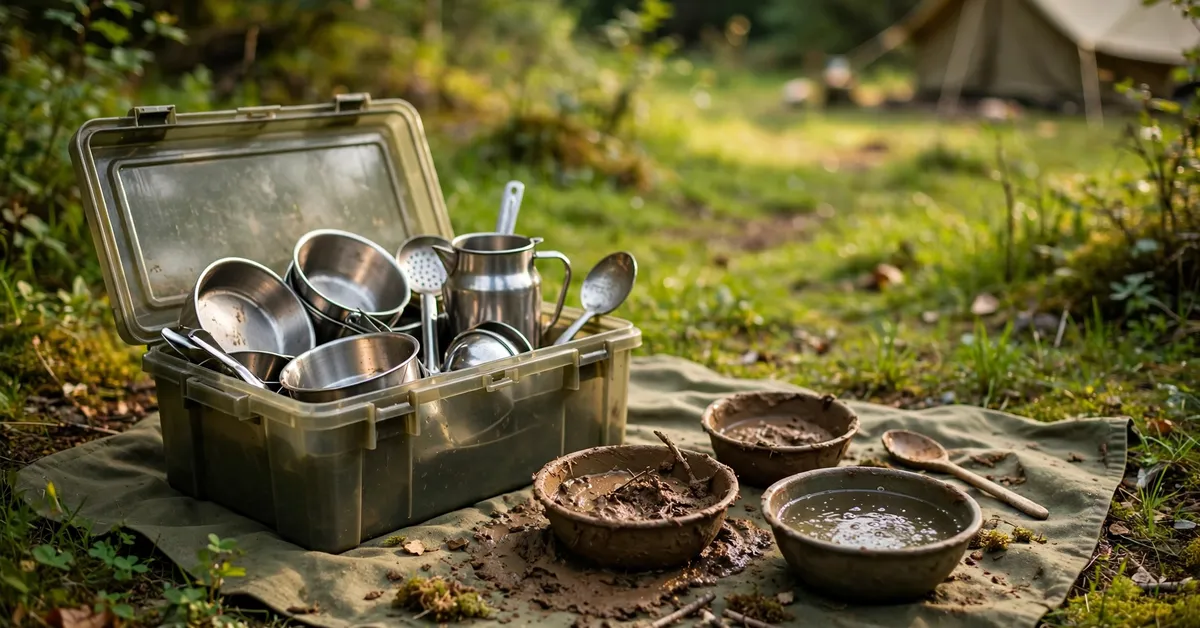
The mud kitchen is the one toy that never comes on holiday. It stands in the garden, built for exactly one patch of ground, while the children go to campsites, holiday cottages, grandparents’ cottages and beaches — all that glorious outdoor time, in places positively upholstered with mud. This post is the fix we worked out after one rainy campsite week too many: the portable mud kitchen. Not a folding product and not a compromise — a kit, packed in one lidded box, that turns any patch of ground with a tap or a stream nearby into a working mud kitchen inside ten minutes. It costs little, weighs less than the cool box, and it has quietly become the most-requested item in our car boot.
What “Portable” Actually Means Here
Let’s be precise, because the phrase invites a picture of a collapsible kitchen with hinges. There isn’t one, and you don’t need one. A mud kitchen is not really the furniture — children will tell you this themselves if you watch them. The kitchen is the system: something to mix in, something to pour with, somewhere to work, water, and mud. The worktop at home is a convenience. On the road, a flat rock, a tree stump, an upturned crate or the box itself does the same job, and children accept the substitution instantly and completely.
So the portable version is a kit built around one rule: everything travels in a single lidded box of about 40 litres, the box doubles as luggage, storage and water carrier, and the whole thing can be set up and — this is the part that matters — cleaned up and repacked by one adult in ten minutes. A portable kitchen that takes forty minutes to hose down is a kitchen that stays home by July.
The Kit List: What Goes in the Box
Edited from the full stocking list in my what to put in a mud kitchen guide — same jobs, travel-weight choices:
- The box itself. A sturdy 40-litre lidded plastic box, the kind with clip handles. It carries the kit, stores it in the garage between trips, and at the site it becomes the water reservoir, the washing-up bowl and, lid on, an emergency worktop.
- Two metal bowls (one mixing, one for the sink role), a metal jug, a ladle, a whisk and a sieve, a muffin tin for pies, and two spoons, one long-handled. All metal, all charity-shop grade — nothing in the box should be precious, because some of it will be lost in grass and nobody’s holiday needs that grief.
- A small hand pump or a collapsible bucket if your sites don’t guarantee a tap; the water-carrying logic is the same as the home setups in my mud kitchen with water pump post, minus the plumbing.
- A groundsheet or old shower curtain, roughly a metre square. This is the unsung hero: it defines the kitchen’s floor, keeps the pitch or the lawn out of the firing line, and at pack-up it wraps the muddy kit for the journey home.
- A pump-action bottle of soap, a flannel, and a microfibre towel in a zip bag — the clean-up station, travel edition.
- A change of clothes per child in a dry bag, because the portable kitchen obeys the same law as the static one: mud first, everything else after.
What doesn’t travel: soil. Never pack soil. Mud’s raw material exists at every destination ever recorded, and carrying a tub of home dirt in the car is the one version of this hobby I refuse to defend at the dinner table.
Setting Up Anywhere: The Ten-Minute Routine
The site routine is deliberately boring, because boring is what survives contact with real holidays:
- Choose the patch. Flat-ish, away from tent doors and other people’s pitches, ideally with the water source in sight. The siting principles from my mud kitchen setup guide shrink down to one question here: where will the muddiest metre do the least harm?
- Groundsheet down, box at the back as the reservoir, bowls and tools laid out in front. This arrangement reads instantly as “kitchen” to children — the groundsheet is doing more psychological work than any furniture would.
- Water fetched first. Fill the collapsible bucket or the box before a single pie is promised.
- The mud supply is local and small: one bowl of soil from a dug corner, a flowerbed edge, the bank of a stream — wherever the site’s rules and common sense allow. The ratios in my how to make mud for a mud kitchen guide work with whatever soil you find; sandy soils want more water held back, clay soils want more added.
- Name the rules once (below), then get out of the way.
Campsite, Park and Beach: The Rules That Change with the Ground
The portable kitchen is played in shared places, so its etiquette matters more than the home version’s:
- Water hygiene travels with you. The core rule from my mud kitchen safety checklist — fresh water, emptied when you finish, hands washed before food — applies at a campsite exactly as at home. Don’t let children mix or drink from stagnant puddles and ditch water; the kit’s own water should come from the tap or the bottle.
- Dig where digging is allowed. On a campsite, that’s your own pitch’s corner, not the landscaping. In a park, use already-bare ground and fallen material rather than excavating the flowerbeds. On a beach, you’re made — sand and seawater-adjacent play below the tide line leaves no trace at all, and a beach mud kitchen (sand kitchen, honestly) is the finest portable version there is.
- Leave the patch better than mysterious. Pack-up means the groundsheet catches the mess, leftover mud is scattered back where it came from, and no kit is left in grass for the mower. Ten minutes, as promised.
- Streams are for looking and dipping toes, under whatever the local rules are — not for damming with the entire muffin tin collection. Use stream water in the bucket if it’s clean and allowed; never block or divert a watercourse for play.
Three Places the Portable Kitchen Earns Its Boot Space
The campsite week. One wet Wednesday is the making of it: the groundsheet kitchen under the awning or a tree, café service for neighbouring pitches, and the social discovery that mud kitchen play is the icebreaker of the camping world. Visiting children arrive with their own bowls within the hour.
The self-catering cottage or holiday rental. Gardens at rentals are usually pretty and always someone else’s — the groundsheet is what makes this version welcome rather than horrifying, and the kit packs back into the box leaving the lawn exactly as found.
The long visit to family. Grandparents without a resident mud kitchen get the full experience on the lawn for an afternoon — if they’d like it more permanently, the visiting-visit setup in my mud kitchen for grandparents post is the next step. The portable kit is also how you find out whether a family member’s garden and patience are truly mud-kitchen ready, at zero commitment.
Rain, Reluctant Players and Other Field Conditions
Rain improves the portable kitchen even more than the static one — the full case is in my mud kitchen in the rain post, and the travel version needs only the same additions: waterproofs, a dry change staged in the car, and warm drinks on standby. A cautious child, meanwhile, often finds the travel kitchen easier than the home one — it’s smaller, it’s theirs to set out, and the gradual ladder from my mud kitchen for reluctant kids guide (dry play, tools as distance, water before mud) works beautifully at box scale. And on the journey home, every part of the kit gets one wash and dries on the line, ready to be forgotten in the garage until the next trip — which is exactly the storage model a thing used six times a year deserves.
What the Whole Kit Costs
Bought entirely second-hand, as ours was: box $8–$15 / £6–£12, charity-shop metalware $10–$20 / £8–£15, collapsible bucket $6–$10 / £5–£8, groundsheet and soap odds and ends from the house. Call it $25–$45 / £20–£35 all-in — less than one day’s campsite pitch fee, for the activity that fills the most hours of the trip.
FAQs
What do you actually pack in a portable mud kitchen kit?
One 40-litre lidded box holds everything: two metal bowls, a jug, a ladle, a whisk, a sieve, a muffin tin and spoons (all charity-shop grade), a collapsible bucket or hand pump, a metre-square groundsheet, and a zip bag with soap, a flannel and a towel. The box doubles as the water reservoir and the washing-up bowl at the site. Soil never travels — every destination has its own.
Can you set up a mud kitchen at a campsite?
Yes, and campsites are its natural habitat. Set up on your own pitch, on the groundsheet, away from tent doors and other pitches; fetch tap water rather than using puddles; and run the same hygiene rules as at home — fresh water, hands washed before food, everything emptied and packed away at the end. Check the site’s own rules on digging and fires of course, but a bowl of soil on a groundsheet offends nobody.
How do you keep a portable mud kitchen clean while travelling?
The groundsheet is the system: play happens on it, muddy kit is wrapped in it for the journey, and everything gets one wash at home before the box goes back in the garage. On multi-day trips, rinse the kit in the box itself with fresh water each evening and tip the water away properly — never leave muddy water standing in the box overnight.
Is a portable mud kitchen suitable for the beach?
It is the finest version of itself at the beach. Sand replaces soil, seawater-adjacent play is for mixing and pouring rather than drinking (bring the kit’s own fresh water for handwashing), and below the tide line the sea does your clean-up for you. Watch the usual beach rules — no kit left behind, and keep glass-free, washed shells only if you collect “ingredients”.
How much space does a portable mud kitchen take up in the car?
One 40-litre box — roughly the footprint of a large cool box, and it stacks. Everything, including the groundsheet and the clean-up bag, lives inside it in the garage between trips, so packing it is a one-item job: box in the boot. If boot space is truly tight, the kit survives being edited down to bowls, jug, sieve, spoons and groundsheet in a 25-litre box.