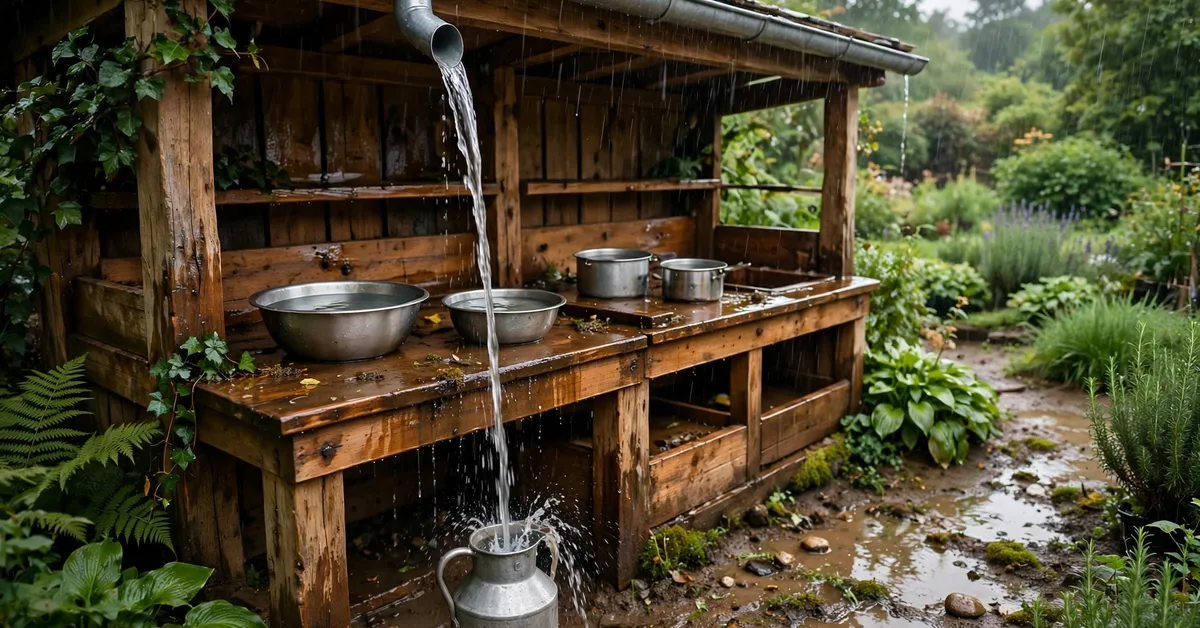
Rain cancels most of the garden. The picnic moves indoors, the ball game is abandoned, the paddling pool sulks under its cover — and one piece of equipment out there is having the best day of its year. A mud kitchen doesn’t merely tolerate rain; rain is a delivery. Free water from above, fresh mud manufacturing itself in every flowerbed, puddles arriving uninvited and asking to be engineered. If your children are currently pressed against the window watching the weather ruin their plans, this post is me making the case that the plans just improved.
There is a catch, and it is the whole secret, so here it is early: a rainy mud kitchen session is won or lost on clothing and the warm-up afterwards — not on the activities. Get those two things right and children will start asking for rain. Get them wrong and you’ve built a memory of being cold in wet socks, which is a memory with a very long half-life.
What Rain Actually Adds
Parents tend to think of rain as the garden with the fun turned down. At a mud kitchen it’s closer to extra features being switched on:
- Mud on tap. Dry spells are the mud kitchen’s only real supply problem; rain solves it continuously and at exactly the right consistency. My how to make mud ratios still matter for the starting batch — after that, the weather takes over production.
- Moving water everywhere. Drips off the worktop edge, a stream down the path, the gutter overflowing in one theatrical spot. Rain turns a static kitchen into a plumbing laboratory, and children who yawn at a filled container will spend forty minutes on a dripping tap’s worth of water if it’s falling from the sky.
- Puddles with a purpose. A puddle near the kitchen is a reservoir, a mixing lake and a boat pond in rotation. Puddles far from the kitchen are just wet — which is why the kitchen’s siting, covered in my mud kitchen setup guide, matters more in October than in June.
- The cast shows up. Worms surface, birds come down to the wet lawn, snails hold a convention on the worktop leg. Rainy sessions have wildlife; sunny ones mostly have wasps.
- The sound of it. Rain drumming on the worktop, dripping into a metal bowl, running off the gutter — a rainy session has a soundtrack, and children go quiet for it in a way they never do for an adult’s request. More than one rainy café service at ours has paused, mid-soup, just to listen.
Dressing for It (This Is the Whole Secret)
The uniform is boring and non-negotiable: waterproof jacket and trousers (or an all-in-one suit for under-fives), wellies, and nothing underneath that you’d mind getting damp anyway. Not a hoodie and hope. Not trainers. The failure mode of every rainy session I’ve ever seen was footwear — wellies are the difference between “we played in the rain” and “my socks were wet by 9 a.m.”
Adults dress to the same standard, in full, no exceptions for “just popping out to check.” You will not pop; you will be recruited to hold a gutter channel, and you will be out there in your slippers, learning the lesson this paragraph exists to prevent.
Two more rules from hard experience. First, no umbrellas at the kitchen — they occupy a hand, drip on the chef, and turn the whole thing into an exercise in umbrella management. Hoods up, hands free. Second, keep a complete dry change — including underwear and socks — staged by the back door before the session starts, not located afterwards by a dripping search party.
Five Rainy-Day Mud Kitchen Activities
1. The rainfall café
Put three identical jugs or measuring cylinders out at different spots — one under the dripping gutter, one in the open, one under the tree — and run the café as normal, except the day’s special is the weather report. Every fifteen minutes, somebody reads the jugs and announces which is winning. It’s a rain gauge wearing a game as a disguise, and it sneaks measurement, comparison and recording into a session the children think is about soup.
2. Channel engineering
A length of guttering, a few bricks, and a slope are the highest-value rainy equipment in existence. Children dam, divert and bridge the water running off paths and patios, testing each design against the live weather. This is the same instinct as the water wall and the pump play in my mud kitchen with water pump post, except the power source is the sky and the engineering budget is zero.
3. Rain painting
Thick paper or card, brushes, and pots of smooth mud and petal dye. Paint quickly, then leave the artwork out in the rain and watch what the weather does to it — colours run, petals migrate, the picture becomes a collaboration. Photograph it before and after; the “after” is the one they’ll talk about, and it’s a first, painless lesson in art that doesn’t have to be permanent.
4. The great puddle diversion
One puddle, one rule: get its water to the mud kitchen using only channels, jugs and engineering — nobody carries it in a bucket, that would be logistics, not science. Sessions have been known to run an hour on this. Sessions have also been known to end with the puddle arriving at the kitchen along with a modest landslide. Both outcomes are education.
5. The warm drink ceremony
The final activity is real and indoors: hot chocolate (or warm squash for the small) served the moment the dry clothes are on, ideally in the mugs reserved for exactly this. Ritualising the warm-up turns “the end of playing” into “the ceremony after playing,” and it is the single most effective piece of repeat-booking marketing a rainy session has.
The Warm-Up System
End every rainy session warm, in this order: waterproofs off at the door (they’re the layer that did its job), straight into the staged dry clothes, towel for the hair, warm drink in hand, and the mud kitchen safety checklist rules still apply — hands washed before the drink, however dramatic the weather. Sessions should be shorter than summer ones: 30–45 minutes is a full rainy session for under-fives, an hour for older children, and the correct ending is “while they still want more,” because next week’s request is the metric that matters.
And one kindness to your future self: the wet kit gets dealt with immediately — waterproofs hung, wellies stuffed with newspaper, mud clothes into the wash the same day. Tomorrow’s session is always easier to start from dry equipment, and a pile of sour wet gear by the back door has ended more rainy-play traditions than the rain ever did.
When Rain Really Does Say No
Three genuine stop signs, and only three. Thunder and lightning — outdoor play ends, full stop, no negotiation, and the celebration moves indoors (my indoor mud kitchen guide is the stand-in). Cold wind with the rain — wet alone is fine, wet plus wind chill is how small children get properly cold, and a session where anyone is shivering is already ten minutes too long. And a waterlogged, flooded garden where the kitchen itself is standing in water — at that point you’re not playing in the rain, you’re documenting a flood.
Note what’s not on the list: ordinary rain, heavy rain, and “it’s a bit miserable out.” Miserable is a clothing verdict, not a weather one. Reading from the southern hemisphere, where winter rain is your season’s main event? The full winter treatment — warm water in the containers, shorter sessions, gumboots — is in my southern hemisphere mud kitchen guide. And if your child is cautious rather than weather-proof — the kind who hovers at the edge — start with my mud kitchen for reluctant kids introduction instead; rain is an advanced course.
FAQs
Can children play in the rain safely?
Yes — in ordinary rain, properly dressed, it’s one of the safer outdoor activities going: no heat, no sunburn, soft ground, and water everywhere for the washing that mud play needs anyway. The real risks are cold (defeated by waterproofs, wellies and shortish sessions), lightning (an absolute stop — outdoor play ends), and wet-plus-wind chill. Warm drink afterwards, dry clothes staged in advance, and the standard handwashing rule before food or drink, and rain is a feature, not a hazard.
What should children wear for mud kitchen play in the rain?
Waterproof jacket and trousers, or an all-in-one waterproof suit for under-fives, and wellies — the wellies are the part families skimp on and the part that decides the session, because wet socks end play faster than any amount of rain. Underneath, old clothes you’d happily retire. Adults wear the same, in full: you will be recruited, and “just popping out” in slippers is how the supervising adult becomes the session’s cautionary tale.
How long should a rainy mud kitchen session last?
Shorter than a summer session: about 30–45 minutes for under-fives and up to an hour for older children is a full, satisfying rainy session. Watch hands and mood rather than the clock — the moment a child is cold, the session was already over. End while they still want more, run the warm-up ceremony properly, and the session buys you next week’s request instead of a refusal.
What if my child hates being wet or getting dirty?
Then rain is not your starting point — it’s the advanced course. Start with the gradual introduction: dry ingredients first, long-handled tools, water play on a dry day, gloves as armour, and let them set the pace with the wash station always in sight. Some children come to rain play via that ladder within a season; some never love the wet and are champion dry-day chefs instead. Both are fine outcomes.
Does rain damage a mud kitchen?
Rain is what a mud kitchen is built for, but standing water and constant damp are what age one: empty containers after sessions so nothing stagnates or freezes split, keep the kitchen’s feet off saturated ground where you can, and give the wood its annual coat of exterior oil. The full routine — cleaning, oiling, winter storage and the refresh for a tired kitchen — is in my mud kitchen maintenance guide.