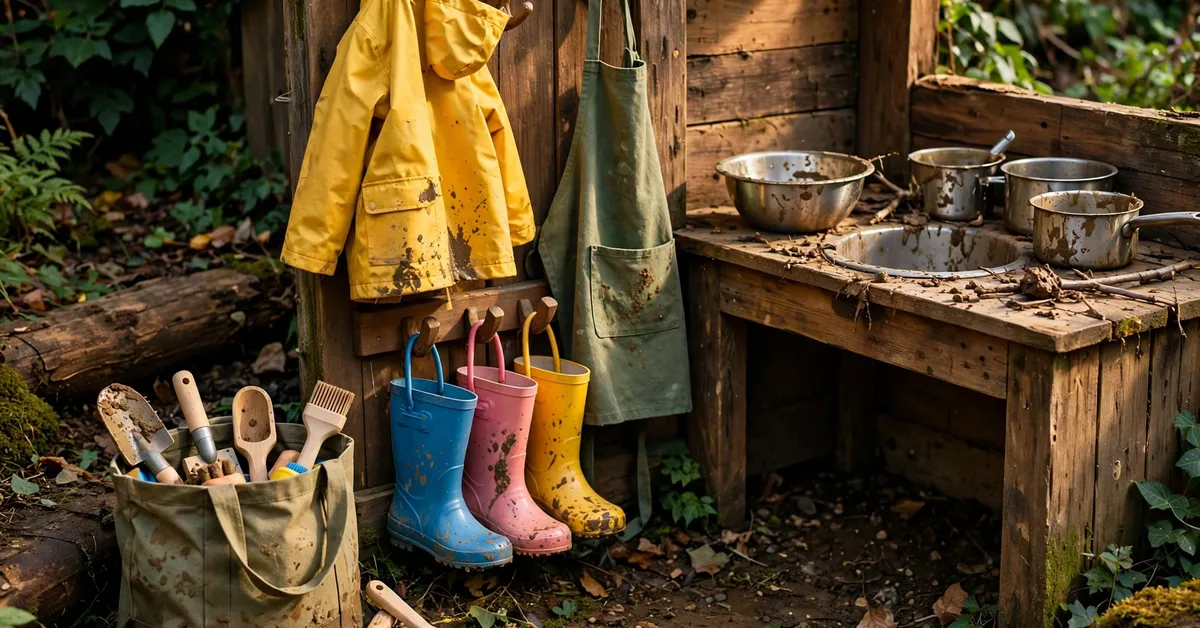
Ask a parent what stops them using the mud kitchen and the answer is rarely the kitchen. It is the clothes. The good coat. The school shoes. The washing pile that already looks like a mountain. Children sense that hesitation instantly, and a child who is told to “be careful” and “don’t get muddy” at a mud kitchen has been given two instructions that cancel the whole point of being there. The fix is not better discipline. It is a kit: a set of clothes that are allowed to get filthy, a routine for getting in and out of them, and a laundry system that means muddy clothes never become a crisis.
This post is that system, for every season and every age. It covers what children actually need (less than you think), what to avoid (more important than you think), how the kit changes from summer to winter, and the laundry routine that gets mud out of everything from wellies to wool. Once the kit exists, the mud kitchen stops being a negotiation and starts being a habit — and children who are dressed for mess play longer, play braver and make a better mess, which is the entire point.
The Kit: What Children Actually Need
The honest kit list is short, and most of it you already own in some form. Start with the feet, because feet decide everything else: wellies, one pair per child, that fit with room for thick socks. Wellies are the perfect mud kitchen footwear — waterproof, washable in a bucket, cheap, and children love them. Trainers get ruined, sandals let mud and stones in, and bare feet (tempting in summer) meet sharp sticks and cold ground. Buy wellies a size up so they last two seasons, and keep a pair of thick socks with them so the kit is grabbed as one thing.
Next, waterproofs: a waterproof coat and waterproof trousers, or an all-in-one puddle suit for toddlers and younger children. The trousers matter more than the coat, because mud kitchen mess comes from below — splashes, kneeling, sitting in puddles. A child in ordinary trousers and a good coat still goes home with soaked knees. For toddlers, an all-in-one is genuinely easier: one zip, no gaps, nothing riding up. For older children, separate coat and trousers last longer and get worn for other outdoor play too, which makes them better value.
Underneath the waterproofs, ordinary old clothes: a long-sleeved top and long trousers that are already stained, already outgrown for best, and officially allowed to get dirty. This is the psychological core of the whole system — clothes with permission. An apron over the top helps for children who like to wipe hands on themselves (all of them), and a hat covers the rest: a sun hat in summer, a warm hat in winter, both washable. Gloves are seasonal and covered in the winter post — thin waterproof gloves under gardening gloves in cold weather, bare hands in summer — and the full seasonal picture is in my mud kitchen in winter and mud kitchen in summer posts.
That is the whole kit. Wellies, waterproofs, old clothes, hat, seasonal gloves. Anything beyond it is either a duplicate (a second pair of wellies for nursery, say) or a luxury, and the next section is about the things that look like kit but cause trouble.
What Not to Wear
The do-not-wear list saves more sessions than the wear list, because most mud kitchen misery comes from one wrong item.
Good clothes, first and obviously: anything you would mind staining should never go near a mud kitchen, and children should never have to guess which clothes are precious. If a child arrives in a good coat, change them before play starts, not after the first splash — the argument after is always worse than the two minutes before. School uniform is the classic trap on weekdays: children come home, go straight to the garden in uniform, and the evening becomes a stain-removal project. The rule that works is simple — uniform off, mud kit on, no exceptions, and the kit lives by the back door so the change takes ninety seconds.
Loose and dangling items are the safety list. Long scarves, dangling drawstrings, loose sleeves that fall into mud and water, jewellery, and anything that can catch on a tap or hook should stay inside. Sleeves should be pushed up or elasticated at the wrist, not flopping into the mixing bowl. Long hair goes tied back, for the same reason: hair in mud is miserable for everyone, and hair near a water container is a hygiene problem. Sandals, crocs with holes, and anything open-toed are out — mud, stones and cold water get in, and a stubbed toe on a wooden edge ends play fast. The standing safety rules in my mud kitchen safety checklist cover the rest, but clothing is where most of those rules actually bite.
One more, because parents ask it constantly: dressing children in white or pale colours for a mud kitchen is a choice, not an accident, and it is a choice that ends in a washing machine full of regret. Dark colours, patterns that hide stains, and fabrics that wash well are the mud kitchen palette. If a child insists on a favourite light-coloured top, let them wear it under a full apron and waterproofs — or accept the stain as the price of a happy afternoon. The stain section below will help either way.
The Seasonal Kit: Summer, Winter and Everything Between
The kit changes with the seasons, but the principle never does: dress for the weather you have, not the weather you wish you had, and keep the changeover easy.
Summer kit is the lightest: shorts or light trousers under waterproof trousers if the day is wet, a t-shirt under an apron, sun hat, sunscreen applied before play, and wellies or old trainers that can be hosed down. Bare arms are fine in summer — mud washes off skin easier than off sleeves — but shoulders need covering in strong sun, and a thin long-sleeved top is worth it on high-UV days even when it feels warm. Water play is heavier in summer, so a spare t-shirt by the door saves the car-seat conversation later.
Winter kit is the heaviest and the most important to get right, because cold ends play faster than any other factor: thermal base layer, fleece, waterproof coat and trousers, wellies with thick socks, warm hat covering ears, and gloves that grip (thin waterproof gloves under gardening gloves, with a dry spare pair by the door). The winter post linked above covers the hand-warming ritual and the session rhythm that goes with it. Between seasons — spring and autumn, when mud kitchen play is at its best — the kit is the middle version: long sleeves, light waterproofs, wellies, and a fleece in the porch for when the sun drops.
The changeover system is what makes all of this painless. Keep the kit together, by the back door, in one box or on one hook per child: wellies underneath, waterproofs on the hook, hat and gloves in the pocket. A child who can kit themselves up in two minutes will ask to play; a child who needs a fifteen-minute search through cupboards will not. Label everything, especially at nursery or school age, because mud kitchen kit looks identical and goes missing at exactly the rate you would expect. And keep a full change of clothes — including underwear and socks — waiting inside, because the day will come when the waterproofs leak, and a warm, dry change turns a disaster into a funny story.
The Laundry System: Getting Mud Out
Here is the part parents actually want: mud is one of the easiest stains in the house, provided you treat it in the right order. The mistake is washing muddy clothes immediately. Wet mud smeared into fabric in a hot wash sets into a stain that never fully leaves. The routine that works is boring and reliable, and it has four steps.
Step one: dry first. Leave muddy clothes to dry completely — outside on the line if possible, or draped over a chair in the porch. Dried mud brushes off. Step two: brush off. Take the dry clothes outside and brush or shake them hard; most of the mud leaves as dust, and what is left is a faint mark rather than a coating. Step three: soak. Soak the brushed clothes in cold water (never hot at this stage) for an hour, or overnight for a bad case, with a scoop of ordinary washing powder or a stain remover. Step four: wash normally, at 30 or 40 degrees, and check before drying — heat from a tumble dryer sets any stain that survived, so if a mark is still there after washing, soak again rather than drying it in.
Grass stains, which come with mud kitchen play as surely as mud does, need one extra step: a dab of washing-up liquid or white vinegar rubbed into the stain before the soak, left for fifteen minutes, then washed as normal. Blood from a grazed knee (it happens) is cold water only, never hot. And wellies and waterproofs barely need the machine at all: a bucket of cold water and a brush outside, left to drip-dry upside down, and they are ready for the next session. The whole system takes five minutes of hands-on time per load, and it is the reason muddy clothes should never be a reason to say no to the mud kitchen.
Sourcing the Kit Without Spending a Fortune
Mud kitchen kit does not need to be new, and in most cases it should not be. Wellies and waterproofs are the most handed-down items in children’s clothing: charity shops, hand-me-downs from older siblings and cousins, and parent groups are full of outgrown wellies with years of life left, and a mud kitchen is exactly where outgrown kit should go for its second act. Buy new only where fit matters — wellies that are too small cause blisters, and waterproofs with broken seams are not waterproof — and buy those a size up so they last.
Labelling is the unglamorous habit that saves money: a permanent marker or iron-on label on wellies, coats and hats means kit comes home from nursery, school and grandparents’ gardens instead of entering the lost-property void. And a small honesty note for the budget-conscious: the kit pays for itself the first time it saves one good coat or one pair of school shoes, which it will do in the first week. The mud kitchen posts on this site about what to put in a mud kitchen cover the kitchen’s own kit; this post covers the children’s, and between the two of them you have the full outfitting picture.
FAQs
Do children need special clothes for mud kitchen play?
Not special — just designated. Wellies, waterproofs and a set of old clothes that are officially allowed to get filthy are the whole kit. The point is permission: once a child has clothes that may get muddy, they stop worrying and start playing properly.
What are the best wellies for mud kitchen play?
Ones that fit with room for thick socks, with a good grip sole and a height that covers the calf. Buy a size up so they last two seasons, and avoid fashion wellies with thin soles — they slip on wet wood and wear through fast. A pair of thick socks kept with the wellies makes the kit grab-and-go.
How do I get mud stains out of children’s clothes?
Let the mud dry completely first, brush it off outside, soak in cold water with washing powder, then wash normally at 30–40 degrees. Never wash wet mud in a hot wash, and never tumble-dry a stain that survived washing — soak it again instead. Grass stains get a dab of washing-up liquid before the soak.
What should children wear for winter mud play?
Layers: thermal base, fleece, waterproof coat and trousers, wellies with thick socks, a hat covering ears, and gloves they can grip in (thin waterproof gloves under gardening gloves, with a dry spare pair by the door). The full winter system is in my mud kitchen in winter post.
What if my child comes home from school and goes straight to the mud kitchen?
Make the change part of the routine: uniform off, mud kit on, no exceptions, with the kit by the back door so it takes ninety seconds. A child in uniform at a mud kitchen is a stain-removal project waiting to happen — and a child who has to “be careful” is not really playing.