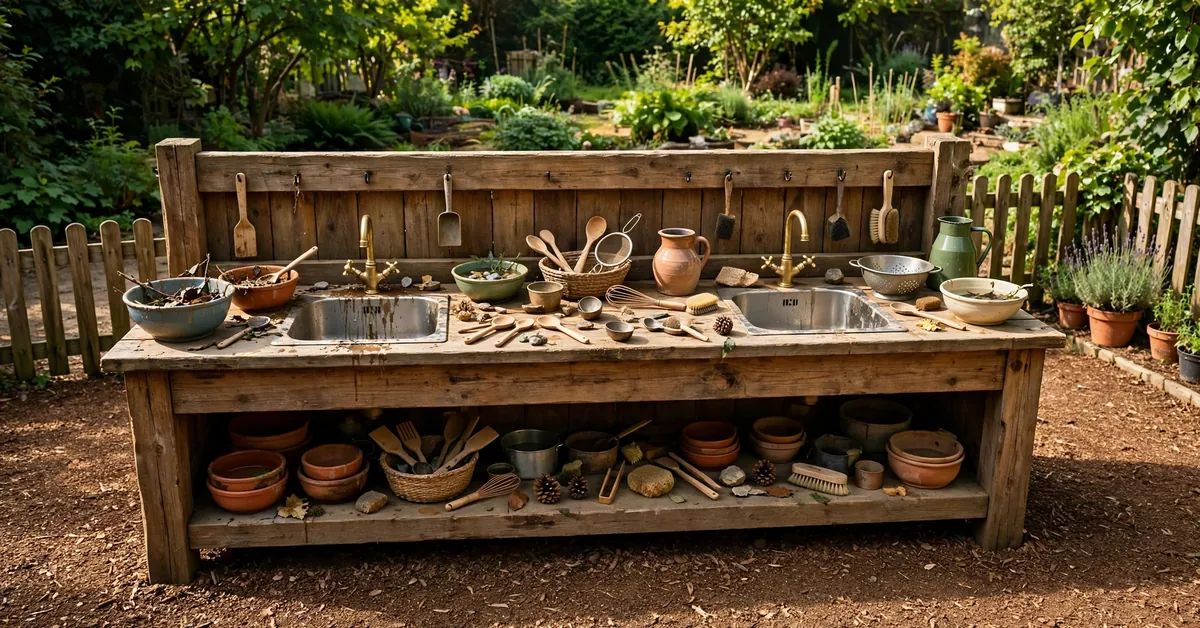
This post is written for a different reader than usual. Not a parent with one kitchen and two children, but a teacher, nursery manager or childminder looking at a patch of outdoor area and thinking: could a mud kitchen work here — for twenty children, on a wet Tuesday, with ratios to keep and a manager’s budget to defend? I’ve built and maintained mud kitchens at home for years, and I’ve spent enough time talking to early-years settings that use them daily to know the home version and the setting version are cousins, not twins. The kitchen is the same. The scale changes everything else.
Here is the setting version, honestly: what to buy or build, how to site it for throughput rather than charm, the hygiene system that survives an inspection, and the running costs nobody puts in the catalogue.
Why Settings Bother (in One Paragraph, Because You’re Busy)
The developmental case — sensory development, early science, language-rich pretend play, the research on soil and wellbeing — is real, well documented, and gathered properly in my benefits of a mud kitchen post, which is the link to send to a governor, inspector or sceptical parent. This post assumes you’re persuaded, or persuadable, and deals with the practical question instead: how a mud kitchen survives contact with twenty under-fives and comes back tomorrow for more.
Choosing the Kitchen: Buy, Build or Convert?
Buying is fastest and, for settings, often the honest best value once staff time is priced in. Choose commercial-grade wooden units from early-years suppliers over domestic garden-centre kitchens: thicker timber, stainless fixings, and worktops at the right height for three-to-five-year-olds (roughly 50–55 cm — the full measurements by age are in the dimensions guidance used throughout this site). Expect $400–$900 / £300–£700 for a unit built to institutional standards. The models parents buy for gardens are compared in my best outdoor mud kitchen for kids roundup — useful background, but treat domestic units as a two-to-three-year proposition in a setting, not a five-year one.
Building works if you have a handy caretaker, a parent volunteer with a workshop, or a local college’s carpentry students looking for a real commission. A pallet-and-timber build to proper plans costs $80–$150 / £60–£120 in materials and a weekend of labour — and has the advantage of being built to your exact space. Settings that build tend to build long: a 2.4 m run of worktop with two sink stations serves a whole key group at once, something no catalogue unit offers.
Converting — a second-hand potting bench cut down to child height — is the budget route some childminders swear by. It works (the method is the same one I used at home) but audit it hard for splinters and stability before a single child touches it.
Whichever route: two water points beat one big one. Every queue, argument and flood I’ve ever heard about in a setting traces back to twenty children and one tap container.
Siting for Throughput
At home, you site a mud kitchen where it looks lovely. In a setting, you site it like a piece of playground infrastructure:
- Visible from the main supervision points — the whole area in one glance, not behind the shed where the interesting incidents happen.
- Away from the door’s main traffic, with a clear muddy zone in front: a bark or gravel standing patch that can take a season of water and be topped up in an hour. Mud will travel about ten steps; zone for it, with the wash station at the boundary between mud territory and clean territory.
- Near the outdoor tap, or accept the refill rota as a permanent staff task. A large lidded reservoir at the kitchen, filled each morning, is the usual answer.
- Shade for the summer term — a sail if no tree cooperates. A kitchen in full June sun empties by eleven.
The Hygiene System (the Bit That Decides Everything)
At home, hygiene is a habit. In a setting, it has to be a system — written, rota’d and visible — because you’re answering to parents, managers and inspectors, not just your own standards. The full rules live in my mud kitchen safety checklist; the setting version adds four things:
- Fresh water daily, emptied nightly, without exception. Standing water is the one genuine hygiene risk in any mud kitchen, and at scale it’s the risk an outbreak investigation would find first. Assign it. Write it on the closing checklist.
- A named soil supply. Settings should run the lidded-tub system with bought topsoil or compost of known origin — never soil dug from ground whose history (old paint, industrial past, cat traffic) nobody can vouch for. A bag of topsoil is about $5 / £4; certainty at that price is the bargain of the year.
- Handwashing as infrastructure, not instruction. A washing station at the kitchen boundary — bowl or outdoor sink, soap, towels — that children pass through as part of the tidy-up routine, every session. Build it into the rhythm and it stops being a battle by week two.
- A weekly deep-clean rota. Utensils scrubbed, containers bleached or replaced on schedule, the standing patch raked, a termly check of fixings and splinters with an adult palm. Fifteen minutes, timetabled, initialled. Boring on paper; the reason settings run mud kitchens for a decade without an incident.
Running It: Sessions, Stock and Storage
Free-flow beats timetabled for most settings — the kitchen as a continuous-provision station, capped at four to six children by a peg or name-band system children can self-manage. Whole-class sessions work for launch days and celebrations (International Mud Day, 29 June, is the big one) but need station planning and a floating adult on water duty.
Stock it for loss. Setting utensils vanish, break and get buried at a rate no home kitchen matches. Buy metal, buy charity-shop, buy double: bowls, ladles, whisks, muffin tins, sieves, jugs. The full kit list is in my what to put in a mud kitchen guide — order from it like a quartermaster, not a parent, and re-stock termly from a small standing budget rather than in a panic each September.
Storage is a lidded box per category — dry ingredients, utensils, dress-up for the café — stacked under the worktop or in the outdoor store, with a photo label for the tidy-up crew. A kitchen that takes twenty minutes to reset gets reset properly once; a kitchen that takes four minutes gets reset every day.
The Costs, Whole and Honest
- Setup: $80–$150 / £60–£120 (build) to $400–$900 / £300–£700 (commercial unit), plus $60–$100 / £45–£75 of utensils and containers.
- Running: a bag or two of topsoil and play sand per term, replacement utensils termly, an annual coat of exterior wood oil ($15 / £12 and one staff hour). Call it $100–$180 / £75–£140 a year, all-in — less than most settings spend restocking a water tray’s accessories.
- Staff time: fifteen minutes of rota’d cleaning a week and a morning a year for the refresh. That is the real cost, and it is smaller than the home version’s, because systems beat habits.
The Launch: The First Week Decides the First Year
Settings that struggle with a mud kitchen almost always struggle in week one, for one of two reasons. Either the kitchen opens with no induction — twenty children, no demonstrated rules, a Friday-afternoon free-for-all that confirms every sceptic in the staffroom — or it opens wrapped in so many rules that the play dies under the signage. The launch that works sits between: a small-group introduction, key group by key group, where an adult plays — makes a pie, washes up at the station, models the tidy-up as part of the game — and states the three rules once, warmly, as how the kitchen works rather than what it forbids: mud stays here, nothing gets tasted, hands get washed. Then open it into free-flow and let the peg system do the crowd control. Tell parents in the same week, with a photo and two cheerful lines in the newsletter: what it is, what the hygiene system is, and which clothes to send. Parents who hear it from you first, as a feature, almost never become the complaint. Parents who discover it via a ruined cardigan become the story. The cardigan, as always, is the whole ballgame.
FAQs
How many children can use a preschool mud kitchen at once?
Four to six comfortably at a standard 1.2–1.8 m kitchen with two water points; more than that and you’re managing a queue, not providing play. A peg or name-band cap that children operate themselves is the usual system. For whole-class events, run the kitchen as one station among several rather than opening it to everyone at once.
What hygiene rules does a nursery mud kitchen need?
Four that matter: fresh water every day and everything emptied at night; a soil supply of known origin (bought topsoil or compost in lidded tubs, never dug soil of unknown history); handwashing built into the end of every session at a station by the kitchen; and a weekly utensil scrub and termly splinter-and-fixings check, rota’d and recorded. Written down, these satisfy most inspectors and nearly all parents.
How much does a mud kitchen cost for a preschool or nursery?
From about $80–$150 / £60–£120 in materials for a staff-built kitchen, up to $400–$900 / £300–£700 for a commercial early-years unit, plus $60–$100 / £45–£75 of utensils. Running costs are roughly $100–$180 / £75–£140 a year — soil, sand, replacement utensils and an annual coat of wood oil. Domestic garden kitchens are cheaper but should be budgeted as lasting two to three years in a setting, not five.
What age group is a setting mud kitchen for?
The sweet spot is two to five years — toddlers tip, fill and transport; three- and four-year-olds run the café play that carries the language and maths; five-year-olds graduate to building, experiments and written menus. Worktop height is the deciding spec: around 40–45 cm for two-year-olds, 50–55 cm for four- and five-year-olds, so a mixed-age setting should choose the middle or provide a low second station.
Do we need planning permission or insurance changes for a mud kitchen?
In most places, no permission is needed for a free-standing mud kitchen in an existing outdoor play area — it’s furniture, not a structure — but settings should do two cheap things anyway: add it to the outdoor-area risk assessment (water hygiene, soil source, supervision sight-lines, splinter checks) and mention it at insurance renewal so it’s on the record. Childminders working from home should check their registration conditions once; it takes one phone call and it’s almost always fine.