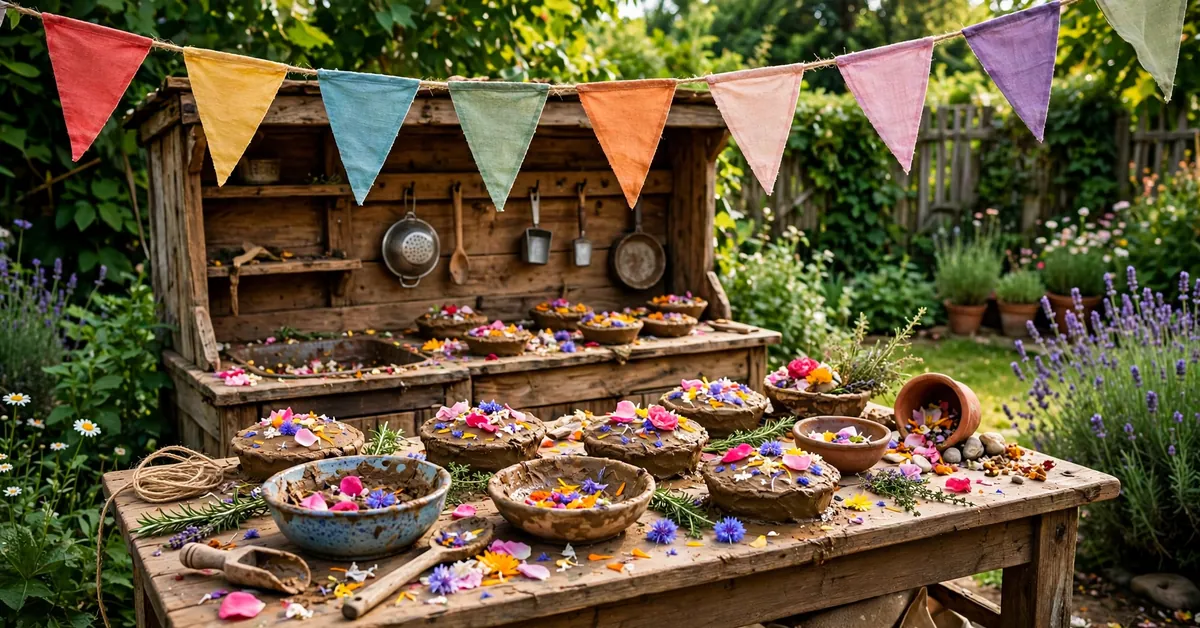
International Mud Day happens every year on 29 June, and most parents I know hear about it on 28 June — from a nursery newsletter, a school WhatsApp group, or a small person who has already decided what they’re wearing. It started in 2009, when an Australian educator, Gillian McAuliffe, and a Nepalese educator, Bishnu Bhatta, connected their classrooms across the world and set their children playing in mud on the same day. It has grown into a genuinely global event — thousands of schools, nurseries and families, one date, a lot of laundry.
Here’s the thing nobody tells you: if you already own a mud kitchen, you are holding the best Mud Day venue in the neighbourhood. You don’t need a festival budget or a field. You need a plan for the water, a plan for the children, and a plan for the clothes. Here is ours, refined over several very brown Junes.
What International Mud Day Actually Is (and Isn’t)
It isn’t a product launch or a charity telethon with a mud theme. The original idea was connection: children in different countries doing the same gloriously simple thing on the same day, and learning a little about each other’s lives in the process. Many schools still twin with a setting in another country or share photos across a link. At home, the spirit scales down happily — the point is deliberate, celebrated, slightly-more-than-usual mud, with the grown-ups joining in rather than supervising from a safe distance.
What it is not: a competition, a cleanliness test, or a day that requires equipment you don’t own. A bowl, a patch of earth and a child who has been told “today, yes” is a complete celebration. The mud kitchen simply lets you do it properly.
The One-Week-Out Checklist
Mud Day failures are never about the mud. They’re about logistics. Run this list the weekend before:
- Clothes. Designate the muddiest outfits in the house — the ones already past saving — for every participant, adults included. Shoes that can be hosed. A change of clothes staged by the back door for the journey back inside, because the return trip is where mud achieves its ambitions.
- Water. Fill every container you own the night before and stage them at the kitchen. Mud Day demand will outrun a single tap container by 10 a.m. — the fresh-water rules from my mud kitchen safety checklist still apply, they just need volume behind them.
- The mud supply. Make a double batch. With the lidded-tub system you can mix it two days ahead and it will be perfect on the morning. A mid-party mud shortage is a genuine mood event; avoid it.
- Towels and a wash station. A bowl of clean water, soap and a towel tree by the door. Plus one dry towel nobody is allowed to use until photographs have been taken, for reasons that will become obvious.
Five Ways to Run the Day at a Mud Kitchen
1. The grand café opening
The classic. The kitchen opens with ceremony — a ribbon across the worktop if you have a child who appreciates theatre — and runs a full café service: stone soup, leaf tea, mud pies with petal icing. The mud kitchen recipes are your menu; write the day’s specials on a board and let the eldest be front of house. This format eats an entire morning without a single request for a screen, which in late June is a small miracle.
2. The science station
Mud Day is the one day a notebook at a mud kitchen looks official. Set up two or three of the investigations from my mud kitchen science experiments — the muddy water filter and the brick strength test are the crowd-pleasers — and let children rotate through. Schools love this version because it photographs well for newsletters and involves the word “investigation”; children love it because the volcano goes off.
3. The build
Bricks in the morning, a wall by lunch, a village by tea. Brick mud (the stiff, clay-leaning mix) packed into small moulds and turned out to dry in the sun is the most absorbing Mud Day activity I know for five-to-seven-year-olds, and the only one that produces a souvenir. Date-stamp one brick with a stick. Ours from three years ago is still in service as a doorstop.
4. The twin
If your child’s school or nursery celebrates, ask — politely, in advance — whether they’d like your photos for their display, or whether the class is twinned with a setting abroad you’d enjoy hearing about at the dinner table. The connection half of Mud Day is the half that sticks: our eldest still talks about the class in Nepal whose mud was red. If you’re home-educating or between settings, a grandparent on a video call, mid-café-service, counts. The founders’ point was never paperwork; it was a child learning that children everywhere play the same game.
5. The southern option
Reading this from Australia or New Zealand? 29 June is your mid-winter, and yes, you can still do it — short session, warm water in the container, gumboots, hot chocolate after. My southern hemisphere mud kitchen guide has the full winter version. A winter Mud Day has a defiance to it that the northern summer edition honestly can’t match.
Mud Day With a Group (School, Nursery or Just a Lot of Cousins)
Groups multiply everything: children, mud, and the need for a system.
- Stations, not a scrum. A café station, a potion station, a build station, a water station. Children rotate; elbows don’t.
- One adult per station, minimum, and one floating adult whose whole job is water refills and the wash bowl. That person is the day’s most valuable player.
- Name the rules once, at the start, cheerfully: mud stays at the stations, nothing gets tasted, hands washed before food. The full list lives in the safety checklist linked above — at group scale it stops being advice and becomes infrastructure.
- Warn the neighbours / notify the parents, depending on venue. A note home — “Mud Day, 29 June, send the clothes you hate most” — prevents the single most common Mud Day complaint, which is a good cardigan.
Why Bother? (The Short, Honest Case)
Because it’s the rare calendar event that costs nothing, needs no tickets, and lands exactly when summer term energy needs somewhere to go. And because deliberate mess — sanctioned, celebrated, joined-in-with mess — does something ordinary play doesn’t: it tells children that the adults aren’t tolerating the mud today, they’re in it. If you want the developmental evidence behind mud play for a school newsletter or a sceptical grandparent, the research is gathered in my benefits of a mud kitchen post. For the day itself, you don’t need the evidence. You’ll have the photographs.
If Your Child’s Setting Isn’t Celebrating
Plenty of schools have never heard of Mud Day, and a parent turning up with a poster and strong feelings is not always the ambassador the day needs. The version that works: a short, friendly message to the teacher in May — not late June — saying the date exists (29 June), that settings mark it worldwide, and offering the one thing teachers actually lack, which is a parent volunteer and a spare pair of hands on the day. Offer to run a station. Bring the towels. Settings adopt Mud Day the way families do: somebody makes it easy, once, and after the first year it defends itself, because the children appoint themselves its marketing department. And if the answer is still no, run your own at home that weekend without a flicker of resentment — the day was never the school’s to grant. Yours is the garden with the mud kitchen in it, which makes yours, officially, the neighbourhood’s Mud Day headquarters either way.
FAQs
When is International Mud Day?
Every year on 29 June. It was founded in 2009, growing out of a connection between an Australian educator and a Nepalese educator whose classes played in mud on the same day. Schools, nurseries and families now mark it worldwide — and because it’s a fixed date, it lands on a different weekday each year, so check whether your child’s setting is celebrating on the day itself or the nearest school day.
What do you need for International Mud Day?
Deliberately little: mud, water, containers and clothes that don’t matter. A mud kitchen turns it from an activity into an event — a café service, a build, a science station — but a large tub of good mud and a bowl of water is a complete celebration. The things that actually make or break the day are logistics: enough water staged in advance, a double batch of mud, and a wash station by the door.
What should children wear for Mud Day?
The oldest clothes in the house, shoes that can be hosed, and — for small children — either a waterproof all-in-one over the top or nothing you aren’t prepared to retire. Send a full change of clothes in a bag if your child is celebrating at school or nursery, plus a plastic bag for the returning evidence. Adults joining in should dress to the same standard; supervising in a clean outfit is a rookie error.
Is International Mud Day only for schools?
No — schools and nurseries made it famous, but it began as a connection between two classrooms and has always belonged just as much to families. A garden mud kitchen, a park meet-up with friends, or a grandparent joining café service on a video call all count. The founding idea was children in different places playing in mud on the same day and hearing about each other; anything that keeps that spirit works.
What if it rains on 29 June?
Then Mud Day has been given exactly the weather it would have ordered. Rain makes fresh mud faster than children can use it, softens the ground for building, and fills every container you forgot to fill. Shorten the sessions, keep the warm change of clothes ready, and lean in — a dry Mud Day is the anomaly worth worrying about, not a wet one. The honest exception is thunder: lightning ends outdoor play, and the celebration moves to the covered porch or the nearest dry day.