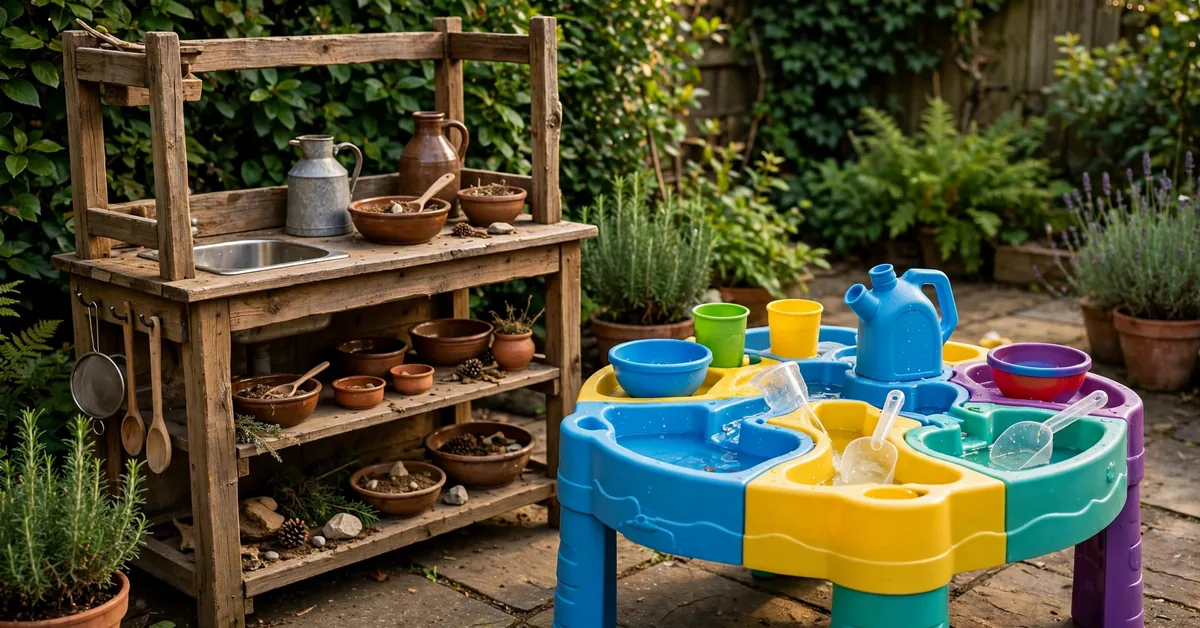
If you have a toddler, a garden and a birthday approaching, someone — a grandparent, usually, standing well back from the consequences — is about to ask the question: mud kitchen, or water table? They’re the two big outdoor play purchases of the under-five years, they cost about the same, they both promise hours of independent play, and they are constantly confused with each other by people who have never cleaned either of them.
We own both. The water table arrived first and had two good summers; the mud kitchen arrived second and is on its fourth year and counting. That isn’t the whole story — the water table earned its shelf space honestly — but it’s the headline. Here is the full comparison, from someone who has hosed down both.
The Short Version
Buy the water table if your child is under two, your space is a balcony or small patio, or the adults in the house have a firm ceiling on acceptable mess. Buy the mud kitchen if your child is two or older, you have any patch of garden at all, and you want the purchase that is still being played with at six. Buy both, in that order, if budget allows and the children are close in age — the water table becomes the mud kitchen’s water supply and everybody wins. The long version is below, because the details are where the real differences live.
What Play Each One Actually Produces
This is the part the product pages won’t tell you. A water table produces water play: pouring, filling, emptying, waterfalls, boats, spinning wheels. It is absorbing, repetitive in the good way, and almost entirely physical — hands in, water down.
A mud kitchen produces pretend play with materials: cooking, cafés, shops, potions, construction. The play has storylines, roles and prices. The child is not just moving water around; she is running a business that serves soup. Both are valuable. But they develop on different clocks — water play peaks at two and three and quietly thins out, while mud kitchen play changes as the child grows: tipping and filling at two, recipes at four, a café with a written menu at six. The full age breakdown is in my mud kitchen for toddlers guide.
Mess and Cleanup: The Honest Section
A water table’s mess is water. It splashes a metre in every direction, soaks the player’s front completely, and evaporates. Cleanup is emptying it (tip it over, done) and the occasional scrub of green film. Ten minutes a week, maximum, and clothing needs a wash only in the sense that it’s wet.
A mud kitchen’s mess is mud, and mud has ambitions. It travels on feet, knees and sleeves; the standing patch in front of the kitchen takes a beating all season; and there is a standing-water routine — everything emptied at tidy-up, fresh water next time — that is genuinely part of ownership. None of it is hard, all of it is real, and my mud kitchen safety checklist has the hygiene side in full. If the thought of mud on the patio makes your shoulders rise, believe that feeling and buy the water table. If you can give mud a corner of the garden and a doormat’s worth of tolerance, the mud kitchen repays it.
Space, Storage and Lifespan
Water table: about a metre across, light, legs often removable, stores in a shed or against a wall. Outgrown — honestly — by about four for most children, though visiting toddlers will resurrect it for years.
Mud kitchen: a metre-plus of permanent garden furniture that lives where it stands, in all weathers, and needs a breathable cover and a half-hour of winter care (the routine is in my maintenance guide) rather than storage. In play terms it lasts from 18 months to seven-plus years — the longest service life of any outdoor toy we own. On pure cost-per-year-of-play, it isn’t close.
Second-hand values tell the same story from the other end. Water tables flood selling groups every spring at a third of their new price, because every family sells at four. Wooden mud kitchens hold their money noticeably better — a sound one, feet checked for rot and given a coat of oil, resells at half to two-thirds of new, and good ones get snapped up in days. Buy the kitchen second-hand and your effective cost of ownership can end up lower than the water table’s.
What Each One Costs
Water tables: $35–$90 / £30–£75 for the sturdy plastic kind with pumps, waterfalls and accessories. No ongoing costs except replacement boats, which sink emotionally long before they sink literally.
Mud kitchens: $50–$150 / £40–£120 for a solid wooden one (the models worth shortlisting are compared in my best outdoor mud kitchen for kids roundup), less if you build from plans or convert something. Ongoing costs are near zero — a bag of play sand, an annual coat of oil — but the utensils accumulate: bowls, ladles, muffin tins, mostly from charity shops in our case.
Weather and Seasons: The Six-Month Question
In a climate with a real winter, the water table is a part-time toy: it comes out in late spring, does its glorious work until about September, and then spends six months in the shed because nobody plays in cold water outdoors. Nothing wrong with that — but price it honestly, as a two-season purchase being used for one.
The mud kitchen plays a longer year. It opens in spring, peaks in summer, and keeps a genuine second season in autumn (warm soil, conkers, shorter sessions). Even in winter it isn’t fully closed: the warm-water trick and frozen-play sessions in my indoor mud kitchen guide stretch it further, and toddlers care considerably less about the calendar than the rest of us. A household choosing between the two is also choosing between a purchase that works about five months a year and one that works nine or ten.
The Hybrid Nobody Mentions
Already own the water table and eyeing a mud kitchen? You are better placed than you think, twice over. First, the water table beside the mud kitchen is a genuinely excellent water station — clean water, at the right height, where the mud stays in its own territory. Several families I know run exactly this setup for years. Second, a water table makes a respectable trial mud station for a toddler: one tray of soil, one of water, twenty minutes, and you will know — with total certainty — whether your household is a mud household before anyone spends real money. If the trial ends in joy, buy the kitchen. If it ends in tears (yours), tip it out, hose it down, and accept the water table’s congratulations.
At a Glance
- Core play: water table = pouring and splashing; mud kitchen = cooking, cafés and construction.
- Peak ages: water table, 18 months to 3 years; mud kitchen, 2 to 7 years.
- Mess: water table = wet clothes and a splash zone; mud kitchen = mud, managed to a corner with routine.
- Cleanup: water table, minutes; mud kitchen, a standing routine plus half an hour twice a year.
- Footprint: water table, ~1 m and storable; mud kitchen, ~1.2 m and permanent.
- Season length: water table, late spring to early autumn; mud kitchen, spring to late autumn, plus winter sessions.
- Cost: water table, $35–$90 / £30–£75 all-in; mud kitchen, $50–$150 / £40–£120 plus pocket-money utensils.
- Verdict in one line: the water table is the best first outdoor toy; the mud kitchen is the best second one — and the last one you’ll buy for years.
So Which One, For Your Family?
- Child under two: water table now, mud kitchen at two or three. Nothing beats a water table at 18 months, and a mud kitchen bought too early mostly waits.
- Apartment, balcony, tiny patio: water table, and it’s not a consolation prize — it’s the right tool for the space.
- Two-plus, garden, mess-tolerant adults: mud kitchen, every time. It’s the purchase still working at six.
- Grandparents asking what to give: the mud kitchen is the bigger, longer gift — my mud kitchen gift guide has the budgets and the order-by dates.
- Siblings spanning toddler to six: both, and let the water table feed the kitchen. The six-year-old will run the café; the toddler will run the water supply and consider herself management.
FAQs
Which is better for a 2-year-old, a mud kitchen or a water table?
At exactly two, it’s close — and the deciding factor is the child. A water-mad two-year-old who lives to pour will use the water table daily; a two-year-old already deep in pretend cooking will take to a low mud kitchen immediately. If you can only pick one and the garden allows it, choose the mud kitchen at two: the water table’s best year is already behind it, while the kitchen’s best years are all ahead.
Which is easier to clean and maintain?
The water table, by a distance. Tip it out, scrub it occasionally, store it dry. A mud kitchen asks for the standing-water routine after sessions, a covered winter, and an annual coat of oil — about half an hour, twice a year, once you know the routine. Neither is a burden; one is simply furniture and the other is a toy, and they ask accordingly.
Can you use a water table for mud play?
Yes — as a trial or a toddler station, it works well: soil in one compartment, water in the other, and everything hoses clean afterwards. As a permanent mud kitchen it falls short: the trays are shallow, there’s no worktop for cooking and serving, and plastic legs aren’t built for a child leaning in with both elbows. It’s a gateway, not a destination.
Do I need both a mud kitchen and a water table?
No — but they are one of the few toy pairs that genuinely complement rather than duplicate. The water table supplies what the mud kitchen lacks (a clean-water station at child height) and the mud kitchen supplies what the water table lacks (a storyline). If budget forces a choice, the choice is by age and space, above. If it doesn’t, buy the water table first and the kitchen a year later.
Which lasts longer, a mud kitchen or a water table?
In play years, the mud kitchen and it isn’t close: roughly 18 months to seven years, against a water table’s core window of about one to four. In physical years, a wooden mud kitchen with basic care outlasts plastic too — plastic goes brittle and cracks in sun and frost cycles, while timber takes a coat of oil and carries on. The water table’s revenge is storage: when it’s done, it folds away in a shed. The kitchen stays in the garden, still working, which is rather the point.