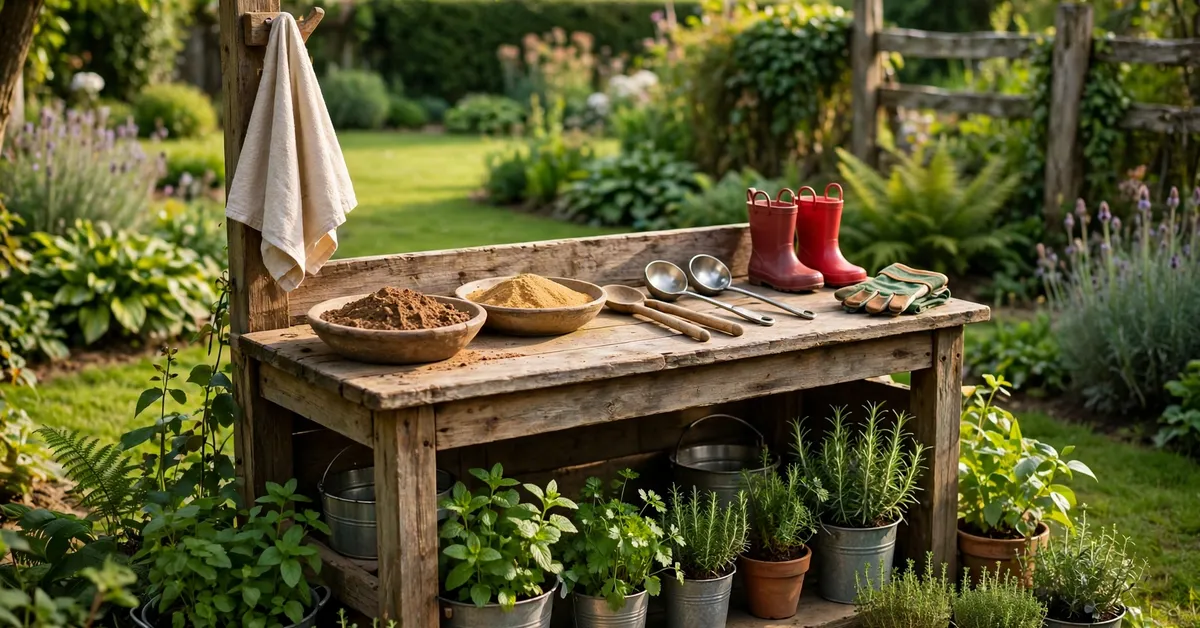
Every mud kitchen has two kinds of visitor. The first kind arrives at a run, sleeves already up, and is mud to the elbows before you’ve said good morning. The second kind hovers at the edge of the patio with clean hands and a thoughtful expression, watching the first kind the way you’d watch weather from a window. This post is for the parents of the second kind — because a child who hates getting dirty is not a child who hates play, and a mud kitchen, introduced properly, is one of the gentlest ways I know to widen what “fun” is allowed to feel like.
The key word is introduced. Nothing in this guide involves picking a child up and putting their hands in anything. That approach works exactly once, and what it teaches is not “mud is fun” but “the mud kitchen is where I get ambushed.” What works instead is a ladder: small, voluntary steps, each one chosen by the child, over days or weeks rather than minutes.
First, Understand What “Hates Mess” Actually Means
Before the ladder, it helps to know what you’re actually looking at, because “won’t touch mud” is a symptom with several different causes:
- Sensory caution. Some children genuinely experience unexpected textures the way you’d experience a loud noise — as too much, all at once. Wet, cold, gritty and unpredictable is a lot of sensation in one handful.
- The ruined-clothes problem. More children than you’d guess have been told off for dirty clothes and have filed mud under “things that get me in trouble.” They aren’t avoiding the mud; they’re avoiding the consequences.
- One bad experience. Mud in a shoe, a slip onto wet grass, something in an eye, eighteen months ago. Small children have long memories for exactly this category of event.
- Watching is their learning style. Some children take in a whole activity by eye before their body gets involved. Hovering isn’t refusal — it’s the first stage of joining in, and rushing it doesn’t shorten it.
None of these is defiance, and none of them is fixed by enthusiasm at volume. All of them respond to the same medicine: the child controls the pace, and the exits are always open.
The Rule That Changes Everything: They Control the Tap
Here is the whole method in one sentence: the reluctant child is never the one mud happens to — they are the one who decides what happens next. In practice that means they choose whether to play at all, they choose the tools, they choose when a session ends, and nobody — sibling, grandparent, well-meaning visitor — is allowed to apply mud to them as a joke. The first time a cousin wipes a muddy hand on the cautious child’s sleeve “for fun,” you can lose a month of progress in one laugh.
Set the kitchen up so this control is real. The wash station from my mud kitchen safety checklist — clean water, soap, a towel — should be visible from the kitchen and pointed out before anything else: “that’s yours, any time, no asking.” A child who can see the way back to clean is a child willing to walk a little further from it.
The Ladder: Six Small Steps, in Their Own Time
Work through these in order, across as many sessions as it takes. A step counts as done when the child chooses it twice, unprompted.
Step 1: Dry ingredients only
Set the kitchen up dry: bowls of dry soil, sand, lentils, dried leaves, conkers. Dry play is pouring, scooping and transporting — most of the fun of a mud kitchen with none of the texture that causes the problem. The stocking list in my what to put in a mud kitchen guide works exactly as written; just leave the water out of it for now.
Step 2: Tools as distance
Long-handled spoons, tongs, sticks, a ladle with a proper handle. Tools are how a cautious child touches mud without touching mud, and there’s no shame in it — professional chefs also use spoons. Offer the longest tools you own and let them stir from what feels like a safe postcode.
Step 3: Water before mud
Water is familiar, it rinses off, and it feels clean even when it isn’t. A session of pure water play at the kitchen — pouring, pumping, floating leaves — builds the “this place is fun” association with zero mud in it. The full water setup options are in my post on a mud kitchen with running water; a simple filled container is honestly enough here.
Step 4: Armour
Gloves and wellies, offered without commentary, change the maths for a lot of children: the mud is there, but it’s not on them. Thin gardening gloves beat thick ones (they can still feel what they’re holding). Some children live at this step happily for a whole summer. That is a successful outcome, not a stalled one.
Step 5: The one-finger stage
Mud painting is the bridge: a stiff brush, a pot of smooth mud, and a fence, a big stone or a sheet of cardboard to paint. The brush is a tool (distance, step 2), but sooner or later a finger gets used to test the paint — their finger, their timing. Smooth, sieved mud matters here; the ratios in my how to make mud for a mud kitchen guide give you a paint consistency that feels like, well, paint — which is rather the point.
Step 6: Hands in, briefly, with the exit lit
It tends to happen mid-game, unannounced: a pie needs patting down, and both hands just do it. Don’t celebrate loudly. Don’t photograph it like a moon landing. Just let it be normal, and have the wash bowl ready for the moment they want out, because wanting out afterwards doesn’t undo it.
Set the Kitchen Up for a Cautious Child
Small adjustments to the standard layout make a real difference:
- Small quantities. A whole tub of mud is a commitment; one bowl is an experiment. Start with one bowl of mud alongside the dry and water options, so mud is one choice among several, never the whole point.
- A clean-zone stool. A stool or mat just outside the muddy area that’s theirs — spectator seat, thinking spot, base. Spectating from a designated throne is a role; spectating from exile is not.
- Their own towel, on their own hook, that nobody else uses. Ownership of the exit equipment is oddly powerful.
- Short sessions with a good ending. Twenty happy minutes that end while it’s still fun beat an hour that ends in tears and a total change of clothes. The general siting and layout principles are in my mud kitchen setup guide — the cautious-child version is just that layout with more exits.
What to Say (and What to Stop Saying)
Retire these phrases: “Don’t be silly, it’s only mud.” “You’ll love it once you try.” “Look, your sister’s doing it.” Each one tells the child their own reading of their body is wrong, and children believe that less than we hope and resent it more than we notice.
Try these instead: “You can watch from the stool as long as you like.” “The long spoon reaches without hands.” “The washing bowl is there whenever you want it.” “Shall I make the mud, or do you want to?” Narration and offers, not verdicts. And when a sibling is involved, protect the ladder: the wild child gets their own station and their own mud supply, because the mud kitchen for toddlers years taught me that nothing derails a cautious child like being in the splash zone of an enthusiast.
When It’s More Than a Preference
Honesty matters here. Most mess-aversion is temperament, and temperament is fine. But if a child’s distress at textures is intense, persistent and spreading — if they can’t bear labels in clothes, certain foods, sand, paint, bath water, and it’s narrowing what your family can do — that’s worth raising with your health visitor or GP, not because a blog said so but because sensory sensitivities sometimes travel with other things and early support genuinely helps. A mud kitchen ladder is a lovely garden tool. It is not a therapy programme, and this post isn’t pretending otherwise.
FAQs
Why does my child hate getting dirty?
Usually one of four reasons: sensory caution (unpredictable textures genuinely feel overwhelming), learned caution (dirty clothes have meant trouble before), one memorable bad experience, or a watch-first learning style where hovering is the first stage of joining in. None of them is naughtiness, and all four respond to the same approach — the child sets the pace, the wash station is always available, and nobody forces contact.
Should I push my child to touch mud, just once, to show them it’s fine?
No. A forced handful teaches one lesson — that the mud kitchen is where adults override you — and children generalise it faithfully: they avoid the place, not just the mud. Every step on the ladder in this post is there because voluntary contact sticks and forced contact backfires. The pie-patting moment nearly always arrives on its own; it just arrives in weeks, not minutes.
What if my child only watches other children play?
Then they’re playing the first stage. Watching is how a large minority of children learn any physical activity, and a child on the spectator stool is taking in the games, the rules and the recipes — ask them afterwards and they’ll describe sessions they “didn’t join” in forensic detail. Give the watching a proper seat, a role if they want one (scorekeeper for the café, keeper of the dry towels), and time.
How long does it take a reluctant child to come round to mud?
In my experience: somewhere between three sessions and a whole season, with most children landing in the three-to-six-session range once the ladder is running — dry play first, tools, water, armour, painting, hands. The children who take a season are not failing; they’re usually the ones whose caution was sensory rather than social, and they often end up the most committed mud chefs of all.
Are gloves cheating at a mud kitchen?
Gloves are equipment, like wellies. A child in thin gardening gloves is stirring, pouring, patting and playing — at the kitchen, in the game, getting the language and the maths and the fresh air — with one layer between them and a texture they find hard. If the gloves come off in July, lovely. If they never do, you still have a child who loves their mud kitchen. That’s the win.