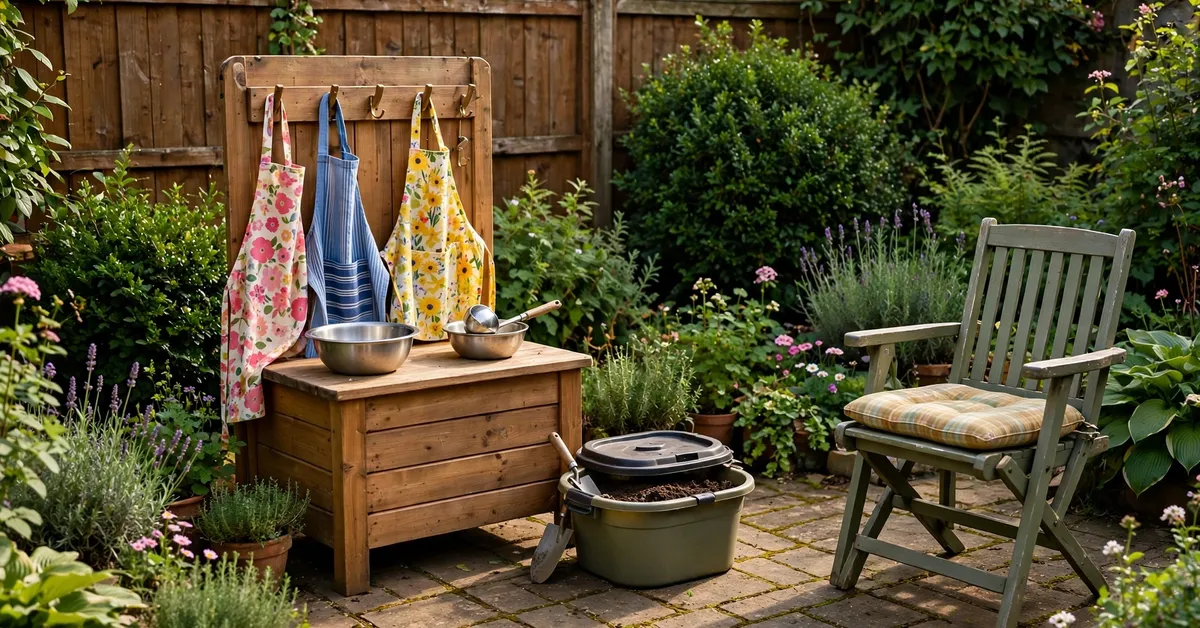
A mud kitchen in a grandparents’ garden plays by different rules. It isn’t used every day — it stands by the fence all week, in the rain, through a heatwave, waiting for Saturday. And when the grandchildren do arrive, it has about ninety minutes to justify its existence before lunch. Grandparents ask me about this version of the mud kitchen more than almost any other, usually in the same words: “We’d love one, but we don’t want a great muddy construction taking over the garden, and we’re not sure we’d keep it up.” This post is the honest answer to that worry. A grandparents’ mud kitchen should be smaller, tougher and easier than the everyday kind — set up once, forgiving of neglect, and ready for action the moment a car pulls in.
Why a Grandparents’ Garden Suits a Mud Kitchen
Start with the good news: the grandparent arrangement fixes the two biggest weaknesses of home mud kitchens. First, novelty. A kitchen a child only sees every week or two never fully wears out its welcome — it greets them like a holiday. Second, the players. Grandparents, in my observation, run mud kitchen sessions better than parents do, because nobody is simultaneously cooking dinner, answering email and reloading the washing machine. The play gets an unhurried adult, and unhurried is the whole game.
What the arrangement breaks is maintenance. A home kitchen gets a glance a day; a grandparents’ kitchen can sit untouched for a fortnight, and everything in the mud kitchen maintenance routine must be adapted for a setup that mostly fends for itself. That’s designable. You just have to design for it on purpose, from the first decision.
Choose Small, Sturdy and Second-Hand
Resist the big catalogue kitchen. For a visiting setup, the sweet spot is a single compact unit — room for two children to work side by side, one bowl, one water container, a shelf. Anything bigger is more surface to clean and more garden surrendered. The best sources are the same ones as always: a sturdy used kitchen refreshed in half a day, following the checks in my second-hand mud kitchen guide, or a simple bench-style build from the mud kitchen DIY plans. If the grandchildren are younger and visiting often, the heights and proportions in my mud kitchen for toddlers post are the ones to copy — but choose the height for the youngest regular visitor, not the oldest, because small children can stand on a step and tall-for-them worktops can’t be lowered.
One decision to make early: whose labour keeps this thing going? The honest answer should be “almost nobody’s”, and every choice below follows from that.
Set It Up So Nobody Has to Bend, Carry or Hose the Patio
Grandparents’ gardens and grandparents’ backs both deserve respect in the layout:
- Site it near the outdoor tap if you possibly can. The ten steps between tap and kitchen are where enthusiasm goes to die, and a heavy watering can is nobody’s friend. If the tap is far away, park a lidded water butt or a large container at the kitchen and accept filling it as part of arrival.
- Put everything between knee and shoulder height. Utensils on hooks on the back board, soil in a lidded tub on the worktop or a stand — not a sack on the ground. The full height guidance is in my mud kitchen dimensions post; for the adults, the rule is simply that nothing in a normal session should require bending to the floor.
- Stand it on slabs, gravel or a bark patch, never straight onto lawn you’re proud of. Mud will claim a metre of ground in every direction. A defined muddy patch protects the rest of the garden and the cook’s blood pressure.
- Face it towards the house. Sessions at grandparents’ houses are supervised with a cup of tea in hand, ideally through a window or from a garden chair. Sightlines are supervision.
The Between-Visits Problem (and Its Ten-Minute Fix)
Here is the bit nobody tells you: a mud kitchen left alone doesn’t stay as you left it. Standing water goes stagnant and green, leftover mud dries into concrete or grows a fur coat, and slugs hold a conference in the bowl. The fix is a closing routine short enough to actually happen, run as the car is loaded:
- Tip out all standing water. Every container, every time. This is the single non-negotiable in my mud kitchen safety checklist — at a grandparents’ house it matters double, because nobody will spot the green bucket midweek.
- Scrape leftover mud into one lidded tub. Wet mud keeps for weeks sealed; left in the bowl it either fossilises or festers.
- Stack the utensils in the sink bowl, lids on the tubs, and that’s it. Ten minutes, and the kitchen that greets the children next time is the one they left, not a science experiment.
If visits are monthly rather than weekly, add one more habit: a quick look-in whenever you’re in the garden anyway, dumping any rainwater that has collected. Thirty seconds, no ceremony.
Stock It Lightly — the Grandparents’ Kit List
The full stocking list lives in my what to put in a mud kitchen guide; the grandparents’ version is that list, edited hard:
- Six to eight metal utensils, total. Bowls, a ladle, a sieve, a muffin tin, a jug. Metal survives being left out; plastic goes brittle and wooden spoons left damp go interesting.
- One lidded tub of topsoil of known origin (bought, never dug from an unknown flowerbed — the safety reasoning is in the checklist linked above), plus a small tub of sand.
- Two aprons or all-in-one suits that live at the grandparents’ house, in the children’s current sizes, replaced as they grow. This single item transforms visits: no parent has to pack for mud, and no good clothes are at risk.
- A towel and a change of clothes that also live there, in a named bag by the back door.
- A stool for the supervising adult, positioned like a throne. Non-negotiable, see above.
The Session Itself: Short, Warm and Predictable
Grandparent sessions run best with a shape the children learn: kitchen first, wash-down second, food third — the same order that works at a mud kitchen birthday party, and for the same reason (mud before food is physics, not preference). Keep a couple of signature activities that only happen here — the recipe book at this house, the special cake mould, the menu written up on the mud kitchen signs board in grandma’s handwriting — because “only at Nana’s” is the most powerful marketing a mud kitchen can have. The standard mud kitchen recipes are your menu; children will vote with their ladles for one house favourite and demand it every visit for a year. Let them.
And if a grandchild is a cautious type who hovers at the edge of the patio, don’t use the visit to push. The ladder in my mud kitchen for reluctant kids guide works just as well across fortnightly sessions — dry play first, tools as distance, the child controlling the tap — and a grandparent’s patience is often the exact ingredient that ladder needs.
What It Costs a Grandparent
Honestly priced: a sound second-hand kitchen at $25–$70 / £20–£55 (or a bench build for less), a lidded soil tub and utensils for $15–$30 / £12–£25, two aprons for $15–$25 / £12–£20 — call it $55–$125 / £45–£100 all-in, against which no toy I’ve ever seen at that price is still in weekly service two years later. Running costs are a bag of topsoil now and then, an annual coat of oil on the wood, and laundry. The real currency is garden space — about a square metre and a half — which is why the small, defined footprint matters more in this version than in any other.
FAQs
What size mud kitchen is best for a grandparents’ garden?
A compact single unit — one bowl, one shelf, room for two children side by side — is the sweet spot. A visiting kitchen doesn’t need the capacity of an everyday one, and small means less to clean, less to store and a smaller patch of garden surrendered. If two grandchildren visit together, choose one worktop wide enough for both rather than two stations.
How do you keep a mud kitchen from going stagnant between visits?
Empty every container of water when the children leave, scrape leftover mud into a single lidded tub, and stack the utensils in the sink bowl. That ten-minute closing routine is the whole secret: standing water is the only genuine hazard in a left-alone kitchen, and it is entirely preventable. For monthly visits, a midweek glance to tip out collected rainwater keeps everything sweet.
What should grandchildren wear for mud play at grandparents’ house?
Keep a dedicated set at the house: an apron or all-in-one waterproof suit in their current size, plus a towel and a full change of clothes in a named bag by the back door. It removes the packing burden from parents, guarantees no good clothes are risked, and children read the house-owned mud kit as part of the treat.
Is a mud kitchen safe for toddlers visiting grandparents?
Yes, with the usual rules applied firmly: fresh water, close supervision, nothing small enough to be a choking risk for under-threes, and soil of known origin kept in a lidded tub. Site the kitchen where it can be seen from the house, and run the session at toddler height — a step for reaching beats a worktop they have to climb towards.
How do you stop a mud kitchen taking over a grandparent’s garden?
Define the mud’s territory from day one: stand the kitchen on slabs, gravel or bark so the muddy metre is a chosen patch, not an expanding one, and keep the whole setup within about a square metre and a half. A wash bowl at the boundary between mud territory and lawn territory does the rest — mud travels about ten steps on small feet, and it helps if most of them are on ground that doesn’t mind.