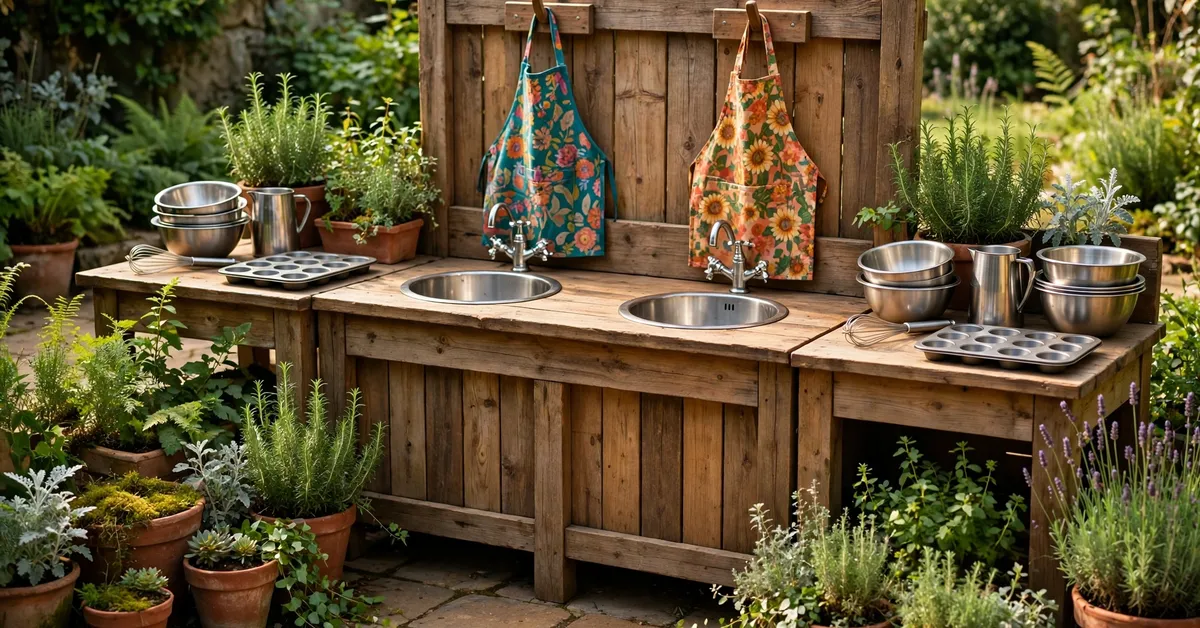
Put two children at one mud kitchen and you will discover, within about four minutes, exactly where its design assumes one child. The queue at the sink. The ladle that exists in a quantity of one. The worktop height that’s perfect for the six-year-old and a climbing frame for the three-year-old. Parents conclude the kitchen is too small, or the children are too many, and start pricing a second one. Almost always, neither is true. Sibling friction at a mud kitchen is a layout problem wearing a behaviour costume — fix the pinch points, duplicate the five things that matter, give each child one piece of territory that is theirs, and the same kitchen serves two or three cooks in a peace that looks, from the garden chair, almost suspicious. This post is the system, learned across two of my own and a rotating cast of cousins.
Why Siblings Fight at a Mud Kitchen (It’s the Layout)
Watch a session before intervening and the pattern is boringly consistent. The fights are not about mud. They are about one water point (every recipe in the building needs it at the same moment), one of each good tool (the whisk, the good ladle, the muffin tin), and one height (somebody is working at their chin or on tiptoe, and uncomfortable chefs are quarrelsome chefs). Settings that serve twenty children solve this with stations and duplicates, as my mud kitchen for preschool guide describes — the home version is the same thinking at family scale: spread the pinch points out and the crowd, even a crowd of two, stops behaving like one.
This is worth saying plainly, because it changes how you feel at 4 p.m. on a wet Saturday: children who fight at a single-station kitchen are not badly behaved children, and parents who referee the same ladle dispute daily are not failing at discipline. You are all standing downstream of a design decision — one sink, one whisk, one height — that manufactures the same argument on a schedule, the way a single-lane bridge manufactures traffic. Engineers don’t lecture drivers about sharing the bridge. They build a second lane. Everything in this post is a second lane.
The Setup Fixes: Width, Water and Duplicates
- Width beats everything. Two children need roughly 1.2–1.8 metres of worktop to work side by side without elbow warfare — the full measurements are in my mud kitchen dimensions guide. If your kitchen is narrower, the answer is a side table, a crate or the ground tray as the second station, not a second kitchen.
- Two bowls beat one sink. The double sink mud kitchen arrangement exists precisely for this: two bowls means two mixtures in progress, two washing-up operations, no queue. A second washing-up bowl dropped into a side crate achieves most of the same peace for almost no money.
- Two water points end the oldest argument. A container tap at one end and the pump or a mud kitchen water wall at the other means nobody’s recipe waits on anybody else’s washing-up. The tap options themselves are in my mud kitchen with working tap guide; the principle is simply that water should never be a single-server queue.
- Duplicate the top five, not the whole kit. Second whisk, second ladle, second muffin tin, second jug, second sieve — the five items every recipe demands at once. The full stocking list is in my what to put in a mud kitchen guide; the sibling edit is to buy the working five twice and let everything else be shared and turn-based.
- Fix the height difference with a step, not a compromise. A sturdy step or platform for the smaller chef at their end of the worktop, both children working at elbow height — the siting basics are the same ones in my mud kitchen setup guide.
Jobs by Size: Playing Together Across an Age Gap
The second design error is expecting siblings to play the same game. At a well-run kitchen they play one game with different jobs in it, sized to the worker:
- The toddler is transport and supply. Carrying water in a small can, delivering leaves and stones, tipping and pouring at their own bowl. This is not a junior role — it is the kitchen’s logistics department, and it happens to be precisely the play a two-year-old wants most, per my mud kitchen for toddlers guide.
- The middle child is production. Mixing, mashing, pie-making, running the recipes from my mud kitchen recipes list — the café’s actual output.
- The oldest is management and works. Writing the menu on the mud kitchen signs board, taking orders, running the till in conkers, and the building projects — the brick-making and experiments from my mud kitchen science experiments post that genuinely suit six-to-eight-year-olds better than anyone.
Roles rotate by session, not by seniority law, and the day the toddler demands to run the till is a good day, not a breach. And if the youngest is still under eighteen months, their station is the taste-safe tray version in my mud kitchen for babies guide, set on its mat within sight — same café, age-appropriate branch.
Territory and Turn-Taking That Actually Work
Systems beat refereeing. Four arrangements have survived contact with real siblings:
- A hook, an apron and a towel each, in their own place. Named, coloured or initialled — it doesn’t matter which, only that it’s theirs. Half of all kitchen disputes are property disputes in miniature, and personal kit retires most of them before they start.
- A project shelf each. One small shelf, crate or tray per child where their ongoing work — the drying brick, the special potion, yesterday’s pie — lives untouchable by law. A child whose work is safe doesn’t need to defend it mid-session.
- The café roster. When the good jobs genuinely can’t duplicate — one menu board, one till — they rotate by day, written up where everyone can see it. A rota a child can read ends arguments a referee can’t, because the board, not a parent, says no.
- The cautious one’s protection. If one sibling is a splasher and the other is the hovering type, give the cautious child the end station, their own mud supply, and first claim on the wash bowl — the full approach is in my mud kitchen for reluctant kids guide, and it applies to siblings exactly as to anyone else. A wild session that costs you the cautious child’s whole summer is too expensive at any price.
When It Still Goes Wrong
Some days the honest answer is parallel play: the portable mud kitchen kit set up as an overflow station on its groundsheet, one chef per kitchen, harmony restored by geography. The station logic from my mud kitchen birthday party guide — spread them out, nothing worth queuing for — works at sibling scale too.
The same applies, briefly, to honorary siblings: cousins and neighbours’ children who arrive for an afternoon count double in the pinch-point maths, because guests make a beeline for exactly the prized items the rota governs. The fix is identical, applied faster — overflow station out, duplicates checked, project shelves declared a demilitarised zone before the first pie. Grandparents running a multi-grandchild garden will find the visiting version of the same systems in my mud kitchen for grandparents guide; the traffic is heavier there, but the bridge-building is the same. And the standing safety rules in my mud kitchen safety checklist apply to the diplomacy as much as the hygiene: fresh water for both stations, no throwing ever, and the adult’s job is the layout and the water supply, not walking around with a whistle. Get the design right and most days you won’t need to — the kitchen runs its own diplomacy, and the adults get to drink their tea while it’s still warm.
FAQs
Do I need two mud kitchens for two children?
Almost never. What you need is width (about 1.2–1.8 m of worktop or a side station), two bowls, two water points and duplicates of the five hardest-worked tools. A second kitchen solves by money what those fixes solve by design — and leaves you with two kitchens to maintain. The genuine exception is a big age gap with very different play, and even then a portable kit as the overflow station usually covers it.
How wide should a mud kitchen be for two children?
Wide enough for two sets of elbows and two bowls: 1.2 m is workable, 1.8 m is comfortable. Height matters as much — if the children are different sizes, a step at one end so both work at elbow height prevents the tiptoe-versus-chin mismatch that causes half the grumbling. Beyond two children, add stations (a crate, a tray, a water wall) rather than more width at one worktop.
What mud kitchen tools should I buy two of?
The working five: whisk, ladle, muffin tin, jug and sieve — the items every recipe wants simultaneously. Two bowls (or a double sink arrangement) complete the peace treaty. Everything else — the special mould, the menu board, the till — can be shared or rotated, and the sharing of those is genuinely good practice rather than a compromise.
How do a toddler and a five-year-old share a mud kitchen?
By job, not by taking turns at the same game. The toddler runs transport and supply — water carrying, delivering ingredients, tipping and pouring at their own low bowl, ideally at a step or with a ground tray at their end. The five-year-old runs production: the recipes, the café, the orders. One game, two roles, and the toddler’s work is real work the café actually needs — which is why it doesn’t feel like being fobbed off.
What if one child dominates the mud kitchen?
First, check the layout: dominance usually means the pinch points are arranged so one child reaches everything first, so spread the stations out and duplicate the key tools before touching behaviour. Then use structure — personal hooks and project shelves, the café roster for the prized jobs, the end station for the quieter child. If one child still treats the kitchen as a solo act, alternate sessions for a week while the systems bed in; sharing a space is learned fastest when the space itself is fair.